
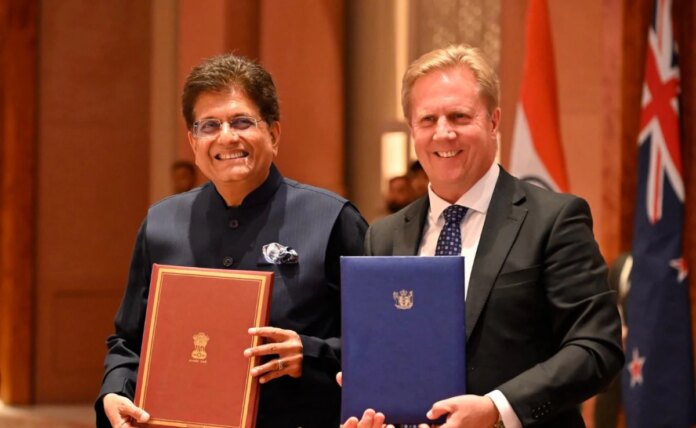

In a landmark development, India and New Zealand have signed a comprehensive free trade agreement (FTA), marking a significant milestone in bilateral relations and global trade diplomacy. In an exclusive interview with NDTV’s Senior Executive Editor Aditya Raj Kaul, New Zealand’s Minister for Trade and Investment Todd McClay described the pact as both an economic breakthrough and a strategic alignment between two like-minded democracies navigating an increasingly volatile global order.
The agreement, finalised within just nine months of negotiations, reflects an unusually rapid pace for trade deals of such scale and complexity. According to McClay, the acceleration was driven by a shared political commitment between Prime Minister Narendra Modi and New Zealand Prime Minister Christopher Luxon, who prioritised deepening ties amid shifting global dynamics.
A Deal Rooted In Timing And Trust
The timing of the agreement is crucial. With geopolitical tensions, supply chain disruptions, and rising protectionism reshaping global trade, the India-New Zealand FTA sends a strong signal in favour of cooperation and rule-based commerce. McClay emphasised that both nations see the deal as a way to provide certainty to businesses at a time when unpredictability has become the norm.
“In a world of great uncertainty, we’ve made a commitment to ensure that our businesses can rely on clear and stable rules,” McClay said, underscoring the importance of predictability in fostering investment and trade flows.
The agreement also reflects a broader shift in India’s trade strategy. After years of cautious engagement, India has recently concluded or revived trade negotiations with multiple partners, including the European Union and Oman. The swift conclusion of the New Zealand deal highlights India’s growing confidence as a global economic player and a trusted partner.
India’s Rising Importance In Global Trade
India’s appeal as a trade and investment destination was a recurring theme during the interaction. McClay pointed to India’s status as the world’s most populous nation and its trajectory toward becoming one of the top three global economies as key factors driving New Zealand’s interest. “India is a growing economy with significant global recognition. For New Zealand, this is an opportunity to partner at the ground floor,” he noted.
Beyond market size, India’s credibility in honouring commitments has emerged as a critical factor. McClay highlighted that the agreement provides a clear framework of rights and obligations, reducing risk for businesses and encouraging long-term investments. This trust factor, combined with India’s manufacturing capabilities and expanding middle class, positions it as a pivotal node in global trade networks.
Balancing Economic Gains And Strategic Goals
The FTA is not merely about market access-it also carries strategic weight. Both countries view their partnership as part of a broader Indo-Pacific alignment, encompassing defence, culture, education, and people-to-people ties.
McClay described the relationship as a “strategic priority” for New Zealand, extending beyond trade to include cooperation in agriculture, technology, and skilled workforce mobility. The agreement introduces a special visa pathway for Indian professionals in sectors such as healthcare, engineering, and information technology, addressing labour shortages in New Zealand while enhancing skill development for Indian workers.
Navigating Sensitive Sectors
Trade negotiations often hinge on sensitive sectors, and agriculture-particularly dairy-was no exception. India has traditionally protected its dairy industry, while New Zealand is one of the world’s leading dairy exporters. However, both sides managed to find a middle ground.
Rather than direct competition, the agreement focuses on collaboration. New Zealand will share technological expertise to improve productivity and earnings for Indian farmers, while also enabling certain products to be processed in India for re-export to global markets.”This is about cooperation, not confrontation,” McClay said, emphasising that the deal avoids zero-sum outcomes and instead seeks mutual gains.
Opportunities Across Sectors
The agreement opens doors across multiple industries. In agriculture, New Zealand’s expertise in high-value products such as kiwifruit, apples, and manuka honey will be leveraged to enhance Indian production. In manufacturing, sectors like leather and footwear-particularly in hubs like Agra-are expected to benefit from increased access to high-quality raw materials and global markets.
The technology sector is another major beneficiary, with fintech collaborations and business expansions already underway. New Zealand firms are setting up operations in India, signalling confidence in the country’s economic ecosystem.
A Response To Global Disruptions
The backdrop of the agreement is a world grappling with economic and geopolitical disruptions, including conflicts in the Middle East and supply chain bottlenecks. McClay cited recent tensions affecting oil routes and trade flows as a reminder of the need for diversified and resilient partnerships.
Both India and New Zealand advocate dialogue and diplomacy over economic blockades and tariffs. The FTA, in this context, acts as a stabilising mechanism, ensuring continuity of trade even amid external shocks.
Looking Ahead
As the agreement moves toward implementation, it is expected to deepen economic integration and strengthen bilateral ties. With bipartisan support in New Zealand and strong political backing in India, the deal appears poised for long-term success.
Ultimately, the India-New Zealand FTA represents more than just a trade pact-it is a statement of intent. In an era marked by fragmentation, it underscores the enduring value of cooperation, trust, and shared growth.