
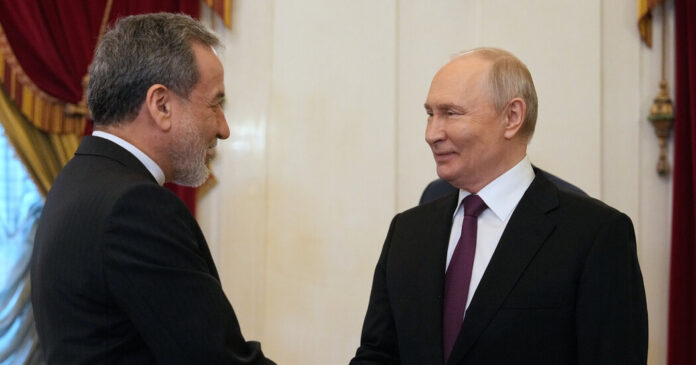

Iran’s foreign minister, Abbas Araghchi, on Monday met in Russia with President Vladimir V. Putin on Iran’s war with the United States, as negotiations between Tehran and Washington to end the conflict appear to have stalled.
But his visit underscored the tricky position Russia finds itself in as it tries to balance its ambitions to remain a key player in the Middle East without damaging its other interests, especially in Ukraine.
In opening remarks ahead of the meeting, Mr. Putin said that he had received a message from Mojtaba Khamenei, Iran’s new supreme leader, and that Russia sees how “courageously and heroically the people of Iran are fighting for their independence and for their sovereignty.” He said Moscow hoped that “guided by their new leader, the people of Iran will endure this challenging period of hardship and peace will prevail.”
“We will do everything in your interests, in the interests of people of the region, so that peace gets achieved as soon as possible,” he said.
Mr. Araghchi’s trip follows a weekend of talks in Pakistan and Oman, which have both acted as mediators in the negotiations. He was supposed to meet with Steve Witkoff, President Trump’s special envoy, and Jared Kushner, the president’s son-in-law, in Pakistan over the weekend, but Mr. Trump abruptly called off the trip.
Mr. Trump’s decision to cancel the trip suggested that the two sides remained far from agreeing on a comprehensive deal to end the war.
After Mr. Araghchi landed in St. Petersburg on Monday, he said he intended to discuss the war with Mr. Putin and other officials and conduct “necessary coordination,” according to Iranian state media.
The consultations with Russia are part of a wider push toward a phased approach to ending the war rather than trying to agree to a comprehensive deal, according to Omid Memarian, a senior fellow at DAWN, a Washington-based organization focused on the Middle East. The war has opened rifts among factions of the Iranian leadership, making it difficult to find common ground on how to end it, he said. At the same time, trying to resolve all the points of contention with the United States at once is a challenge.
“A phased approach — first ending the war and reopening the Strait of Hormuz, then moving to broader negotiations — could give both sides a limited interim victory and create space for talks under less pressure,” Mr. Memarian said, adding that Mr. Putin has often used his ties with Iran as leverage in his broader dealings with Washington. “Mr. Putin may be Iran’s last card in trying to persuade Trump to accept such an arrangement.”
But even though Russia is a key ally of Iran, it has sought to avoid becoming too entangled in the conflict, said Nikita Smagin, an analyst based in Baku, Azerbaijan, who specializes in Russia’s role in the Middle East. Mr. Putin’s main interest, he said, is to persuade Mr. Trump to press Ukraine to accept a peace deal favorable to Moscow.
Russia has also tried to maintain strong ties with Israel and the Persian Gulf countries that Iran has attacked in response to the U.S. and Israeli military offensive that began in late February.
Russia has been “largely limiting its interaction with Iran,” said Mr. Smagin, adding that this approach was “rational,” given Russia’s long-term interests in Ukraine.
“Russia is still trying to be cautious in the areas where Iran needs it most — primarily regarding the supply of weaponry,” he said.
But, he added, Russia also does not want “to ruin her relationships with the Gulf states, Israel and Trump.”
A major issue in the negotiations is the fate of Iran’s enriched uranium. In April, the Kremlin reiterated its readiness to take that uranium. In 2015, Russia took delivery of most of the Iranian stockpile under the nuclear deal that was later canceled by President Trump.
Shortly after the United States and Israel attacked Iran, Russia condemned the strikes as a “deliberate, premeditated and unprovoked act of armed aggression.”
Moscow has also provided intelligence to Tehran, including satellite imagery showing the locations of American warships and military personnel, according to U.S. officials. European officials have warned that Russia may be preparing to deliver advanced drones to Iran.
In addition, Moscow has provided diplomatic cover for Iran at the United Nations, vetoing a resolution that called for countries to cooperate to open the Strait of Hormuz. And Mr. Putin and Sergey V. Lavrov, Russia’s foreign minister, have maintained regular contact with their Iranian counterparts.
Russia and Iran do not share a border, but they trade via the Caspian Sea, a link that has become more important since the American blockade of Iranian ports.
Mr. Smagin pointed out that Moscow-linked facilities in Iran, including the Bushehr nuclear plant where Russia is building two reactors, have been attacked at least four times, according to Iranian officials. In March, Russia’s foreign ministry said a consulate in Isfahan, a city in central Iran, was damaged in an attack and that a Russian Orthodox church was damaged in Tehran this month. Russia has condemned the attacks but did not retaliate.
Iran has blocked most shipping through the Strait of Hormuz in the Persian Gulf, a crucial transit route for oil and gas supplies, and the Trump administration has blockaded Iranian ports in response. That has created a surge in global energy prices, which in turn has provided a windfall for Moscow. That windfall, though, is temporary.
“Despite the fact that Russia is technically “winning” — having unexpectedly stumbled into a massive influx of dollars — it risks losing everything in terms of actual influence,” Mr. Smagin said. “In this sense, we see Russia trying to carefully find the right ‘keys’ to exert some level of influence.”