
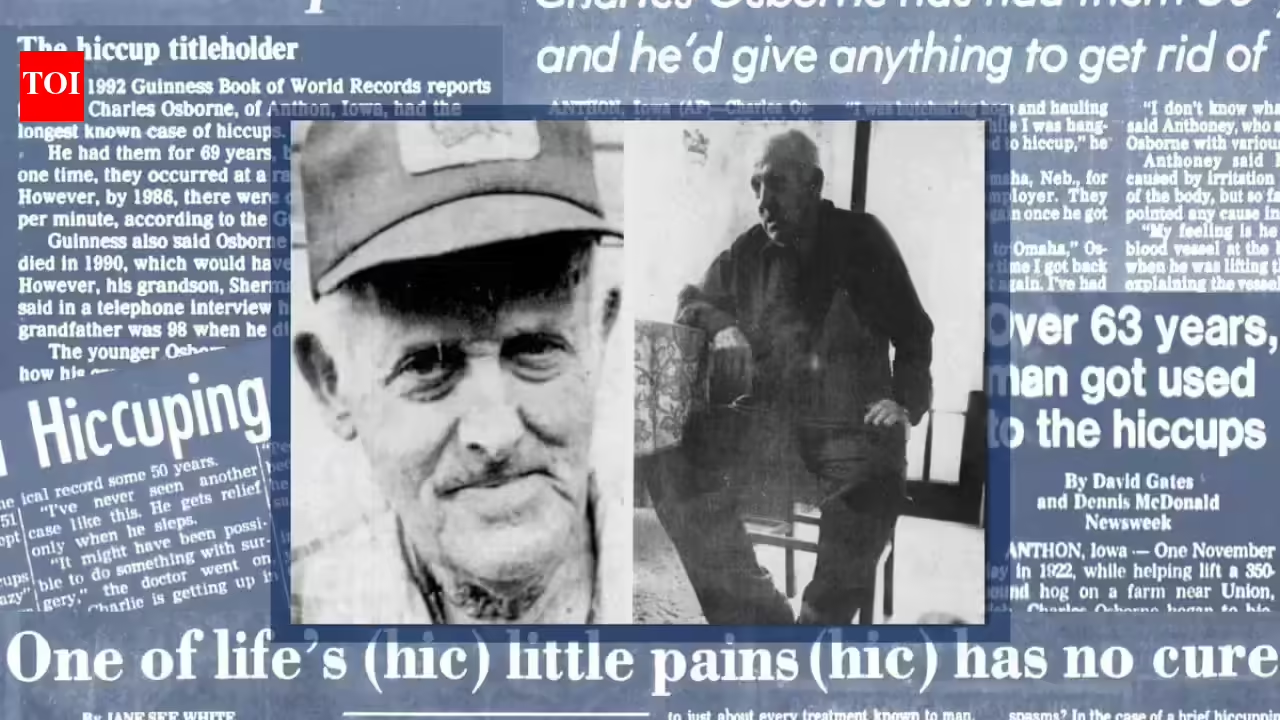

Hiccups may not affect the majority of people because it is usually considered just another temporary inconvenience. They usually go away in a matter of minutes and might leave nothing but some slight frustration and awkward laughter. But hiccups affected one American so deeply that he experienced the problem his entire life, and doctors could not stop the condition nor understand it fully. A farmer named Charles Osborne is believed to have had continuous hiccups for an incredible period of 68 years. His story does not seem to be any less believable at this very moment, when many unique medical stories emerge online all the time. The case, which started back in 1922 on the farm of Charles, turned out to be one of the strangest cases of a long-term disease. And even now, scientists can speculate only about possible causes and the sudden disappearance of the condition.
How Charles Osborne’s hiccups reportedly began
The bizarre story reportedly started on 13 June 1922 while Charles Osborne was working on a farm in Nebraska. According to several accounts, the young farmer was preparing a hog for slaughter when he suddenly developed hiccups. Some reports suggest he may have strained himself while lifting the animal, while others claim he experienced a small injury during the task. Whatever happened that day, the hiccups did not stop.At first, Osborne probably believed the condition would disappear naturally. Most people expect hiccups to fade after drinking water, holding their breath, or simply waiting for a short while. In his case, though, the spasms continued hour after hour and eventually stretched into days, months, and years.Doctors later suggested that Osborne might have damaged a tiny blood vessel in the part of the brain responsible for controlling the hiccup reflex. This theory was never fully confirmed, though it remains one of the most widely discussed explanations connected to the case.
Living with chronic hiccups for nearly seven decades
Charles Osborne’s condition eventually became one of the most famous examples of chronic hiccups in medical history. Reports suggest that in the early years, he experienced around 40 hiccups every minute. Over time, the frequency reportedly slowed to around 20 hiccups per minute, though the condition never completely disappeared for decades.Despite the constant interruptions, Osborne appears to have adapted remarkably well to everyday life. He reportedly married twice, raised children, continued working, and remained socially active. Friends and neighbours are said to have admired his patience and good humour despite the exhausting condition.Living with nonstop hiccups for such a long period could not have been easy. Chronic hiccups are known to cause exhaustion, sleep problems, weight loss, and emotional stress in many patients. Even ordinary hiccups can become frustrating after only a few hours, which makes Osborne’s case feel almost unimaginable.Some reports suggest that he developed special breathing techniques to reduce the sound of the hiccups while speaking. Small adjustments like that may have helped him maintain conversations and social interactions more comfortably over the years.
The mystery ending that nobody fully understands
Perhaps the strangest part of Charles Osborne’s story came near the very end of his life. In February 1990, after nearly 68 years of constant hiccups, the condition suddenly stopped without any clear explanation.There was reportedly no miracle treatment or major surgery responsible for the change. The hiccups simply disappeared.For Osborne, the silence after decades of nonstop interruptions must have felt extraordinary. He reportedly lived for more than a year without hiccups before passing away in May 1991. By the time of his death, Charles Osborne had experienced an estimated 430 million hiccups. His case remains one of the longest-recorded episodes of chronic hiccups ever documented and continues to fascinate both medical experts and ordinary readers today.