

The fate of a shaky cease-fire between Iran and the United States is yet again uncertain, with President Trump first issuing threats of renewed war against Iran on Sunday before saying a day later that planned attacks had been paused amid “serious negotiations.”
But the Iranians have been preparing for a possible resumption of strikes and have signaled that they will not hesitate to extract a heavy price from neighbors and the world economy if they are attacked.
Here’s how Iran might respond.
What is Iran anticipating?
In the first round of war this year, the Iranians were bracing for a prolonged conflict of around three months, said Hamidreza Azizi, an expert on Iranian security issues at the German Institute for International and Security Affairs.
As a result, Iran limited its use of missiles to sustain weeks of attacks against Israel and regional targets, he said.
By contrast, if war breaks out again, Iranian leaders expect fighting to be “short but high intensity,” including coordinated heavy strikes on Iran’s energy infrastructure, said Mr. Azizi, who follows public commentary by government-affiliated experts and those close to the military or security establishment.
How might Iran retaliate this time?
In any new round of fighting, Iran may fire off tens or hundreds of missiles per day to “effectively confront the enemy and also change the calculation on the other side,” Mr. Azizi said.
That will leave Gulf Arab nations having to brace for intensified attacks on their energy infrastructure. Striking Gulf oil fields, refineries and ports is one of the most potent ways for Iran to inflict pain on the global economy and put pressure on Mr. Trump. If the damage is major enough, it could suck countries like the United Arab Emirates, Kuwait and Saudi Arabia even deeper into a war that many Gulf leaders have sought to avoid.
Iranian officials and government-aligned analysts have engaged in vitriolic anti-Emirati threats and rhetoric over the past several weeks, driven by their view that the U.A.E. has enabled attacks on Iran by hosting U.S. military installations. Recent news reports have disclosed that the U.A.E. and Saudi Arabia carried out secret attacks on Iran during the U.S.-Israeli onslaught.
“We must certainly return the Emirates to the era of riding camels — and we can do this,” Mehdi Kharatian, an analyst who is close to Iran’s security forces, said in a podcast interview last month. “If necessary, we will occupy Abu Dhabi.”
However hyperbolic the statements, they “reflect important currents of thinking” within the leadership of Iran’s Islamic Revolutionary Guards Corps, Ali Alfoneh, a senior fellow at the Arab Gulf States Institute, said in an email.
Mr. Alfoneh dismissed reports of a potential Saudi-Iranian nonaggression pact as “entirely unrealistic.”
“The threat of Iranian retaliation against major oil producers remains one of the very few factors restraining U.S. behavior toward Iran,” he said.
What other cards does Iran have?
Iran could also try to exert control over the Bab-al-Mandeb Strait, a narrow waterway connecting the Red Sea to the Gulf of Aden through which one-tenth of global trade passes. The waterway sits alongside territory held by an Iranian-backed militia in Yemen, the Houthis.
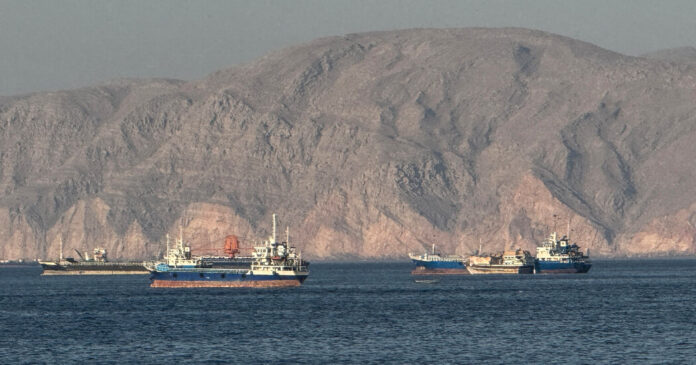
In the last round of fighting, the Iranians used their proximity to the Strait of Hormuz, another critical trade waterway, to exert immense leverage over the world economy. If the Iranian government believes its control over that strait is in jeopardy, it may want “to make the United States focus on two maritime fronts instead of one” Mr. Azizi said.
Mr. Kharatian said in the podcast interview last month that if the United States were to strike Iranian economic infrastructure, Iran would retaliate by limiting traffic in the Bab-al-Mandeb.
That might keep up the pressure on the global economy — but the maneuver may prove complicated.
The Houthi militia has vowed to defend Iran in case of a regional war, but it responded cautiously in the last round of fighting. Analysts attributed that to calculations over how much of its dwindling military stockpiles the group could afford to use.
Vivian Nereim contributed reporting.