
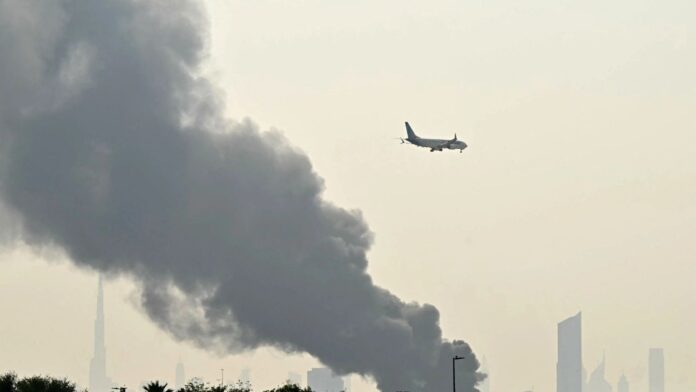
A HIGH-tech wall of steel is being mounted around the Gulf region to fend off Iran’s attacks.
Warships armed with laser cannons, drone whisperers and commandos on “ghost ships” are among the game-changing weapons deployed.
It comes after Iran’s demands for a virtual surrender by the US and withdrawal from the region were rejected by Donald Trump as “garbage”.
The president said a ceasefire between Washington and Tehran is now on “life support”.
American destroyers, fighter jets and Apache helicopters are continuing to hunt down IRGC fast boats threatening commercial ships in the contested Strait of Hormuz and blast enemy coastal batteries.
A Qatari tanker turned back to port Tuesday as it approached islands from where Iranian rocket-firing boats and torpedo-carrying Ghadir submarines launch out of concealed inlets and underwater caves.


Another cargo ship was reportedly hit near the port of Qatar, and satellite images show a tanker on fire and leaking oil.
Iranian drones have also struck the UAE, Kuwait and Saudi Arabia since US destroyers responded to an IRGC weekend attack.
Iranian cruise missiles and kamikaze drones were “incinerated” by laser weapons shot from the destroyers, according to the Pentagon.
Trump said: “They dropped to the ocean like burning butterflies onto their grave.”
But with the threat of Iran’s assault looming large, Ukrainian anti-drone specialists are being brought in by the Gulf states to leverage their expertise.
Ukraine comes under fire from lethal Shahed drones blasted by Russia every day – and those same kamikaze weapons now threaten Arab kingdoms.
Ukraine has developed acoustic radar systems with special sensors that recognises the distinctive lawn mower sound of Shaheds on inbound trajectories.
It triggers interceptor drones that shoot into the sky – scoring 90 per cent kill rates.
The wall of steel being built in the Gulf region is designed to mirror Ukraine’s Sky Map system.
It cleverly connects a network of sensors, radars and cameras placed around cities and military bases – which triangulates the approach of incoming drones.
Radars often miss low-flying Iranian Shaheds – but the Sky Map fills the gap by picking up their distinctive noise.
All the data is fed into a control centre in Saudi Arabia, with a live map of approaching threats.
It issues alerts to trigger small interceptor drones that hunt down and obliterate targets.
The Sky Map can also be accessed by warships equipped with new laser weapons designed to “fry” drones in midair.
But it could also be used by ground units coming under threat in denied areas.
It may not be enough, however, to hold back the IRGC’s growing missile offensive as the regime ignores Trump’s red line on abandoning nuclear weapons development and handing over of enriched uranium.
Western intelligence analysts fear IRGC chief Ahmed Vahidi, a terrorist mastermind who operated as a special ops agent with Hezbollah organising suicide truck bombings in the Middle East and South America, is the main power in Iran.
An officer of Argentina’s secret service, speaking on condition of anonymity, told The Sun that while operating under diplomatic cover in Buenos Aires, Vahidi directed attacks.
Those assaults used plastic explosive-packed vans driven by Hezbollah fanatics, blowing the Israeli embassy and a Jewish community centre – killing more than 100 people.
He handed out bribes worth $250,000 (£190k) to local officials so they would look away as explosives and suicide teams were smuggled in, according to the source.
Despite being on Interpol’s red list, Vahidi became defence minister under president Mohammed Ahmedinejad.
They then initiated weapons-grade uranium enrichment, acquiring high-grade uranium from Bolivia, where he and Vahidi visited repeatedly.
The IRGC chief is the only person in direct contact with current Supreme Leader Mojtaba Khamenei, who is supposedly lying crippled and disfigured at an unknown location.
Mojtaba has never been seen in public and many believe he is dead – serving as a cardboard cutout for Vahidi.
The terror chief’s rogue clandestine skills have kept him out of US and Israeli crosshairs as scores of other top IRGC thugs were eliminated.
But top Delta Force and Seal Team Six commandos specialised in intricate snatch operations and high-level assassination may be plotting a major hit in Iran.
Their “ghost ship” was recently spotted at UK-US island base of Diego Garcia, a staging area for operations in the Gulf.
The converted unregistered cargo vessel is equipped with helipads, accommodation for 150 men, and satellite-linked surveillance and electronic warfare systems.
The ship was last seen off Venezuela when Delta Force took Nicolas Maduro.
It comes as the UK has deployed a new low-cost missile system in the Middle East to shield forces and citizens from drone attacks.
The new Advanced Precision Kill Weapon System (APKWS) is being fitted to RAF Typhoon fighter jets – enabling them to destroy targets precisely and at a fraction of the cost of missiles currently used.
March saw a successful test strike on a ground-based target, and RAF Typhoon pilots from 41 Test and Evaluation Squadron conducted successful air-to-air firing in April.
The system has now been deployed in the Middle East with sorties flown by 9 Squadron RAF Typhoon fighter jets as part of the missions to defend British people, interests and partners from threats.