
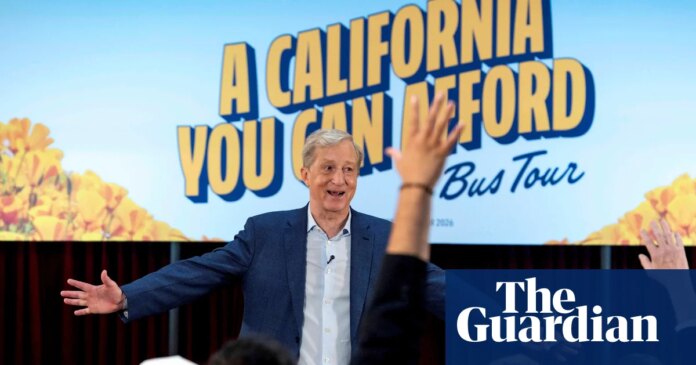

Tom Steyer has built his campaign for governor of California around affordability – and taxing the uber-wealthy.
It is perhaps an unusual message for a candidate with an estimated net worth of $2.4bn. But the hedge fund founder-turned climate activist and liberal mega-donor is pitching himself as a different kind of billionaire: one who wants people like him to pay far more in taxes.
As early voting ballots trickle in for the 2 June primary, Steyer a leading candidate in the unsettled contest, is racing to convince Californians that his elect-the-rich-guy-to-eat-the-rich candidacy isn’t a contradiction.
“People are very skeptical of billionaires,” Steyer, wearing a beige baseball cap with the words “class traitor” embroidered on it, told a small group of reporters at a campaign event in East LA on Wednesday. “I’m skeptical of billionaires because we’ve seen so many billionaires being selfish and arrogant.”
Steyer’s campaign arrives at a particularly combustible political moment in the US, shaped by a surge in anti-elite populism, widening income inequality and growing suspicion of billionaire power across both parties.
A survey conducted last year by the Harris Poll found that the share of Americans who said billionaires threaten American democracy rose to 53%, up 7 points from 2024. At the same time, nearly eight in 10 respondents said they were more likely to support a billionaire who “challenges unjust systems”.
Since Donald Trump’s return to office, millions have flocked to hear Senator Bernie Sanders excoriate the 1% on his cross-country Fighting Oligarchy tour. In New York, the city’s new democratic socialist mayor, Zohran Mamdani, celebrated tax day by filming a video outside billionaire Ken Griffin’s $238m Manhattan penthouse to promote a tax proposal on luxury second homes. Earlier this month protests erupted over the involvement of Amazon founder Jeff Bezos’s involvement in this year’s Met Gala.
“You can’t earn a billion dollars,” Representative Alexandria Ocasio-Cortez of New York said in a podcast interview earlier this month, setting off a heated debate.
Anti-rich sentiment is especially pronounced in the Golden State, which boasts the world’s fourth largest economy and more billionaires than any other US state. Yet California faces a deep affordability crisis, leaving many voters searching for a governor who will do more than take on the billionaire in the White House.
They want someone who will “upend the system”, said Lorena Gonzalez, president of the powerful California Federation of Labor Unions.
A decade after Trump, a billionaire real estate mogul, proved he could harness working-class discontent, Democrats see a chance to rebuild their frayed coalition and win back the voters squeezed by the rising cost of rent, utilities and groceries. Ahead of the November midterm elections, Democrats are hammering Trump over his coziness with Silicon Valley billionaires and his preoccupation with building a ballroom at the White House, evidence, they say, that the president’s party has abandoned working class voters in favor of a new gilded-age oligarchy.
“There’s no question that we think working people represent working people best,” said Gonzalez, whose union issued a multi-candidate endorsement of Steyer, former congresswoman Katie Porter and former LA mayor Antonio Villaraigosa. But, she continued, “if there is a billionaire who says, ‘I will take on this entire system, shit, all right, let’s see.”
Steyer is not the only Democrat testing the party’s appetite for a populist from the 1%. In Illinois, Governor JB Pritzker, a scion of the Pritzker family that founded the Hyatt hotel chain, is running for a third term – and widely believed to be considering a presidential bid in 2028.
Other wealthy progressives include Saikat Chakrabarti, a centimillionaire tech entrepreneur and former chief of staff to Ocasio-Cortez who is self-funding his anti-establishment bid to succeed retiring former House speaker Nancy Pelosi in San Francisco.
Wealthy Democrats are hardly a new phenomenon. From Franklin Roosevelt’s patrician roots to John F Kennedy’s vast family fortune, the party has a history of elevating affluent political leaders who framed their privilege as a responsibility to serve the public. As Cas Mudde, a leading scholar of populism, noted by email, “socialists have long been led by ‘class traitors’ (eg Friedrich Engels) or have supported rich politicians and intellectuals (for example Bernie Sanders and Noam Chomsky)”.
In progressive San Francisco, Mayor Daniel Lurie, a moderate Democrat and heir to the Levi Strauss fortune, governs with a technocratic style reminiscent of Mike Bloomberg, the billionaire who served three terms as New York’s mayor – and residents love it. A recent poll showed 74% approval of his job performance.
Across the country, however, Democrats are confronting a rising anti-establishment backlash, with the party’s rank-and-file, still seething from the party’s 2024 losses to Trump, embracing the economic populism of candidates like oyster farmer Graham Platner in Maine and seminarian James Talarico in Texas.
Amid a volatile job market and escalating inflation, voters want leaders who understand their economic struggles. In California, with the nation’s highest cost of living and gas prices topping $6 per gallon amid the Iran war, that demand is particularly urgent.
Perhaps then it is a sign of the times that if Steyer advances to the November general election, Californians would likely have the chance to elect a billionaire for governor and impose a first-of-its-kind wealth tax on the state’s richest residents. Steyer has said he would vote for the so-called “billionaire” tax that has drawn the ire of some of the state’s richest tech leaders.
That, in part, has helped Steyer consolidate support among progressives in the state, including Representative Ro Khanna, whose Silicon Valley-based district is the wealthiest in the country. He also earned the somewhat begrudging endorsement of the California Democratic Socialists (DSA) of America, which wrote that Steyer was “somehow” the most progressive candidate in the race “despite being a billionaire” who earned his wealth through the “exploitation of the working class”.
In the governor’s race, Democrats briefly fretted a lock-out scenario, in which two Republicans would advance to the general election – a quirk of the state’s nonpartisan primary system. Surveying the field of Democratic aspirants, many on the left saw few better options.
“We fundamentally believe billionaires are a policy failure,” said Joseph Geevarghese, executive director of the Bernie Sanders-founded Our Revolution, whose endorsement helped cement Steyer as the leading progressive in the race. “But in this case, he is the person most aligned with our values.”
Steyer’s spending has dwarfed his rivals. Since launching his campaign seven months ago, he has spent more than $132m – and counting – of his own money to saturate the California airwaves and pay social media influencers, some of whom have failed to disclose the payments.
His opponents have tried to make his accumulation of wealth a vulnerability. At a debate last month, Porter, one of Steyer’s Democratic rivals for governor, attacked him over investments made by the hedge fund he founded and stepped back from in 2012. Steyer, she said, was a “billionaire who got rich off polluters and ICE prisons and is now using that money to fund this election”.
Funding his own campaign, Steyer counters he “can’t be bought” – an echo of Trump’s appeal in 2016, when he cast his Republican rivals as beholden to a corrupt political system. On the campaign trail, Steyer reminds voters that while he is the only billionaire on the state ballot he is “not the only billionaire in this race”, pointing to the corporations and tech executives spending against his campaign.
“If the teachers and the nurses and the cafeteria workers and the hotel workers and the people who work in schools stand up for me, that’s my crew,” Steyer said in East LA. “If the working people of this state understand that I am for them 100% then I’ve done my job.”
Self-funders have a long record of losing, as Steyer knows personally after an unsuccessful run for the White House in 2020. Bloomberg also ran for president that year, spending $1bn and winning only one primary contest: the Democratic caucus in American Samoa.
“If you have a vast amount of personal wealth, you have cleared one of the biggest hurdles that candidates often are worried about, which is, how will I fund my campaign?” said Michael Beckel, the director of money and politics reform at Issue One, a nonpartisan political advocacy group. “But at the end of the day … voters must also like a politician’s platform and ideas.”
At Steyer’s campaign event on Wednesday night – a stop on his “A California You Can Afford” tour, featuring “free” tacos and face painting – there were signs his “tax me more” pitch was resonating.
“Honestly, if it takes a billionaire who wants to be taxed more and wants to use that money to help people, then at this point, he’s our guy,” said Duane Paul Murphy, a 30-year-old who lives in the San Fernando Valley.
Carla Ramirez, 66, who came from the Antelope Valley with her husband, liked much of what she heard Steyer say. Deeply alarmed by the concentration of wealth in America, she wants the state’s next governor to enact bold change, like the kind she sees Mamdani setting in motion as mayor of New York.
“Right now, our country is run by billionaires,” Ramirez sighed. By the evening’s end, she still wasn’t sure – at least not yet – if California should be run by one, too.