
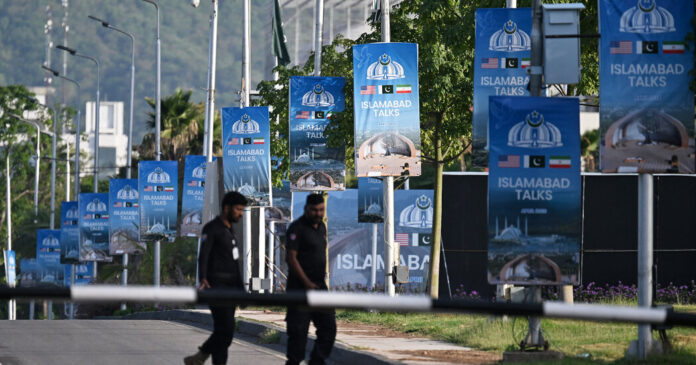

President Trump called off a trip by two of his top negotiators to Islamabad, Pakistan, on Saturday, just before they were set to leave for talks about a potential deal to end the war in Iran.
“I’ve told my people a little while ago, they were getting ready to leave, and I said, ‘Nope, you’re not making an 18-hour flight to go there. We have all the cards,’” Mr. Trump said in a statement. “They can call us anytime they want, but you’re not going to be making any more 18-hour flights to sit around talking about nothing.”
On Sunday, Abbas Araghchi, the Iranian foreign minister, returned to Islamabad, after having left it on Saturday, according to Iranian state media.
But the cancellation of the Americans’ trip is the latest sign that Iran and the United States are far from reaching a deal to end the war. Many sticking points remain, including the fate of Iran’s highly enriched uranium and the reopening of the Strait of Hormuz, which both sides are attempting to blockade.
Iran has publicly rejected peace talks during the U.S. naval blockade of its ports, which is aimed at crushing the Iranian economy and pressuring Tehran to make a deal.
What’s the latest?
Mr. Araghchi said on Saturday that he had shared with Pakistani officials Iran’s position on a “workable framework to permanently end the war on Iran.” He did not give details of the latest proposal.
But the talks hit a snag shortly after Mr. Araghchi wrapped up Saturday’s round of meetings and left for Oman for a day. Mr. Trump abruptly announced that some of his top aides — including Steve Witkoff, Mr. Trump’s special envoy, and Jared Kushner, the president’s son-in-law — would not travel to Pakistan for a new round of discussions.
Officials in Pakistan have been mediating between the United States and Iran to try to end more than a month of war in the Middle East.
The decision to call off the U.S. trip to Islamabad was the second setback for Pakistan’s mediation efforts in less than a week. Mr. Vance was also expected to travel to Islamabad earlier this week before canceling at the last minute.
Mr. Araghchi returned to Pakistan on Sunday ahead of a planned trip to Russia, according to Iranian state media.
Tensions have remained high in and around the Strait of Hormuz, a crucial conduit for Persian Gulf crude oil and natural gas. Both Iran and the United States have continued to seize vessels they said have violated their restrictions on shipping in the waterway.
Iran’s nuclear program
Some of the core sticking points between the United States and Iran are the scope of Iran’s uranium enrichment program and the fate of its stockpile of enriched uranium. Iran insists it has a “right” to enrich nuclear fuel under the Nuclear Nonproliferation Treaty.
Mr. Trump has repeatedly said that he will not allow Iran to possess a nuclear weapon. But he is also confronting the complicated legacy of his decision, eight years ago, to cancel what he has called “a horrible, one-sided deal” to curtail Iran’s nuclear program.
That Obama-era agreement — formally called the Joint Comprehensive Plan of Action, or J.C.P.O.A. — suffered from flaws and omissions. It would have expired after 15 years, leaving Iran free after 2030 to make as much nuclear fuel as it wanted. But once Mr. Trump withdrew from the deal in 2018, the Iranians went on an enrichment spree much sooner, leaving them closer to a bomb than ever before.
Much recent attention has focused on Iran’s half-ton of uranium that has been enriched to a level close to what is typically used in atom bombs. The majority of it is thought to be buried in a tunnel complex that Mr. Trump bombed last June. But those 970 pounds of potential bomb fuel represent only a small fraction of the problem.
Today, international inspectors say, Iran has a total of 11 tons of uranium, at various enrichment levels. With further purification, that is enough to build up to 100 nuclear weapons — more than the estimated size of Israel’s arsenal.
Virtually all of that cache accumulated in the years after Mr. Trump abandoned the Obama-era deal.
What is ‘nuclear dust’?
In recent weeks, Mr. Trump has been talking about a substance he says is key to ending the United States’ war against Iran: “nuclear dust.”
In the president’s telling, Iran’s nuclear program was so badly damaged by U.S. bombs last year that all that remains under the rubble is a sort of powdery aftermath.
The phrase “nuclear dust” seemed designed to diminish the importance of what Mr. Trump is actually talking about — Iran’s stockpile of near-bomb-grade uranium, which is stored in canisters about the size of large scuba tanks.
The material is not, in fact, “dust.” It is typically a gas when stored inside the canisters, though it becomes a solid at room temperature. It is a volatile and highly toxic substance if it comes into contact with moisture and, if mishandled, can trigger a nuclear reaction.
A clash of negotiating styles
Mr. Trump views himself as the master of coercive diplomacy, forcing his opponents to capitulate quickly to American demands or face the threat of attack.
But in dealing with Iran over the past six weeks, he has discovered that he is up against a nation that prides itself on resilience and delay.
“Trump is impulsive and temperamental; Iran’s leadership is stubborn and tenacious,” said Robert Malley, who negotiated with the Iranians in the lead-up to the 2015 nuclear deal and again in a failed effort by the Biden administration.
“Trump demands immediate results; Iran’s leadership plays the long game,” Mr. Malley continued. “Trump insists on a flashy, headline-grabbing outcome; Iran’s leadership sweats every detail. Trump believes brute force can compel obedience; Iran’s leadership is prepared to endure enormous pain rather than concede on core interests.”
The last big U.S.-Iran negotiation, completed 11 years ago, took the better part of two years, moving from secret talks with a then-new Iranian president with a pragmatic bent to a full-scale negotiation involving scores of meetings.
Mr. Trump is clearly sensitive about potential comparisons. “The DEAL that we are making with Iran will be FAR BETTER than the JCPOA,” he said on social media. “It was a guaranteed Road to a Nuclear Weapon, which will not, and cannot, happen with the deal we’re working on.”
David E. Sanger and Luke Broadwater contributed reporting.