
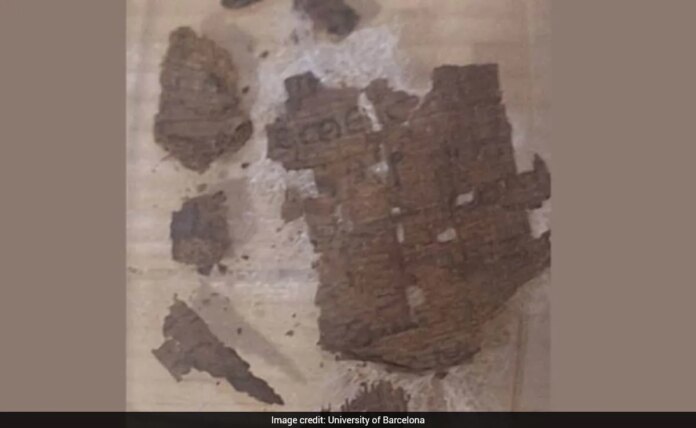

A 2,000-year-old mummy discovered in Egypt has revealed an unusual link between ancient Greek literature and Egyptian burial rituals. Archaeologists found a fragment of Homer’s “Iliad” sealed in a clay packet and placed outside the mummy’s wrappings.
This marks what researchers believe is the first known case of a Greek literary text being used directly in the mummification process, New York Times reported.
The discovery was made at Oxyrhynchus, an ancient burial site in central Egypt, by a team from the University of Barcelona.
The mummy belonged to a non-royal man from the Roman period.
Experts say the damaged papyrus contained lines from Book 2 of the “Iliad,” specifically from the “Catalogue of Ships,” which lists the Greek forces that sailed to Troy. The text mentioned commanders, including Guneus and Tlepolemus and detailed the number of ships they led into battle.
Researchers believe the papyrus may have carried spiritual significance and was intentionally placed on the body during embalming.
“The find is incredibly significant, primarily for the discovery of such a papyrus with Greek literary text in its original context,” Egyptologist Foy Scalf of the University of Chicago told the NYT.
The papyrus was recovered from Tomb 65. Leah Mascia, a specialist in Greco-Roman Egypt at the Free University of Berlin, worked with conservator Margalida Munar and linguist Ignasi-Xavier Adiego to stabilise and decode the text.
Their study suggests that Roman-era funerary customs in Egypt had evolved beyond traditional burial manuals like the “Book of the Dead”. Instead, sealed papyrus packets containing literary passages, magical texts and records were being placed with the dead as part of alternative rituals.
Oxyrhynchus, located around 120 miles south of Cairo, is one of Egypt’s richest archaeological sites. Excavations there have earlier uncovered hundreds of thousands of papyrus fragments, including lost writings linked to ancient Greek poets and playwrights like Sappho and Euripides.
Historians say Greek identity carried social prestige in Roman Egypt, and literary texts may have reflected that status even in death.
Anna Dolganov of the Austrian Archaeological Institute suggested the “Iliad” may have been placed with the dead as “cheat code” to secure a smooth passage into the Greek afterlife. This possibly reflected a way to avoid the harsh tests linked to Egyptian beliefs about the afterlife.
The ongoing excavation project has also unearthed mummies fitted with golden tongues and copper ritual objects believed to help the dead speak before Osiris, the Egyptian god associated with judgment and resurrection.
In another part of the burial site known as Sector 42, archaeologists found large jars filled with cremated remains. One jar contained the bones of an adult, a baby and a cat, along with pieces of cloth.