
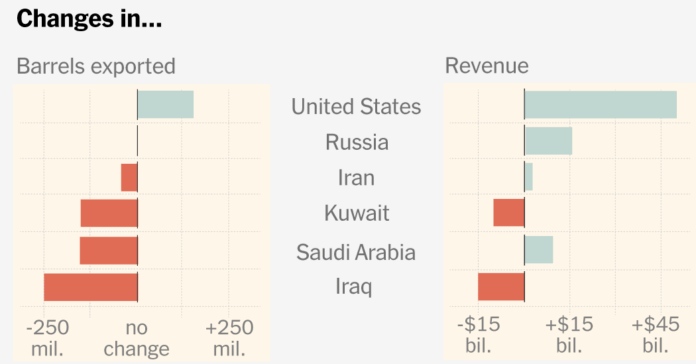

The U.S.-Israeli war with Iran thrust the world into its worst-ever energy crisis, slashing oil production and sending prices soaring. Those much higher prices have generated windfalls for companies that operate outside the Persian Gulf — especially in the United States, which has been selling a lot more energy than usual.
But inside the Persian Gulf, the story is much more complicated. The effective closing of the Strait of Hormuz, a choke point between the Gulf and the rest of the world, has forced the United Arab Emirates, Iraq and other countries to slash production and exports. Some are hurting worse than others. Those that can use pipelines to reroute their oil to ports away from the strait have fared a lot better than countries without such options.
This energy crisis affects everyone, but not evenly. The New York Times analyzed months of export and pricing data from S&P Global Energy Commodities at Sea and Argus Media to assess how much some of the world’s biggest oil producers have been selling and at what price. The analysis looked specifically at oil and related products exported by sea, which have been most affected by the closure of the strait.
Understanding who is winning and who is losing in that group helps explain why some countries are better positioned to withstand the economic consequences of this war. It also provides clues about the future. If the strait is no longer a reliable conduit, today’s winners are likely to remain dominant. If it the strait reopens, countries’ ability to recover will be informed by how painful the shutdown has been for them.
“The longer the strait stays closed, those who have gained from this will continue to gain,” said Jim Burkhard, who leads global oil research for S&P Global Energy. “Those who are challenged by it, it could get more serious for them.”
United States
The United States is the world’s biggest producer of oil and natural gas, cushioning the economic blow from a war that it and Israel started. By late March, U.S. companies were exporting much more oil, diesel and other fuels than normal. That helped make up for a small portion of the energy the world has lost and kept prices from rising even further.
But unlike many other big oil producers, the United States does not have a state-owned oil company. That means big oil companies are receiving the large majority of this extra revenue. So far, there is little sign they will reinvest those proceeds to drill more or to hire more workers. That means there is unlikely to be a big war-related economic boom in Texas, New Mexico and other oil-producing states.
Instead, much of that extra revenue is likely to benefit investors in the form of higher stock prices and dividends. Many state governments will also earn more because they will receive bigger tax and royalty payments, as will landowners who have allowed oil drilling on their property.
Russia
Russia has been another big beneficiary — not because it is selling more oil, but because it is being paid more for its oil. The main reason is that the war has caused oil prices around the world to soar. The United States also temporarily lifted sanctions on some Russian oil in March, an abrupt policy shift that most likely helped Russia receive more for its oil than it otherwise would have. In early April, for example, the price for Russian oil sold off the Gulf of Finland approached $120 a barrel, up from $41 before the war. That said, Ukraine has sought to limit Russia’s ability to capitalize on higher prices by attacking the country’s oil infrastructure.
Persian Gulf
Most producers in the Persian Gulf have not been as fortunate. If anything, the war has underscored the importance of having export outlets other than the Strait of Hormuz. Saudi Arabia and the United Arab Emirates have fared relatively well because they invested years ago in oil pipelines that go around the strait, an expensive form of insurance that is paying off. Saudi Arabia’s exports have fallen by over 150 million barrels during the war, compared with a year earlier, but its revenue from those sales rose by an estimated $9.2 billion.
Iran, which has been controlling access to the strait, also fared relatively well through mid-April. But the country’s exports plunged after the United States imposed a naval blockade targeting vessels linked to Iran, further straining the country’s economy.
Nearby countries that have neither control over the strait nor alternative export routes have been hit especially hard. They include Iraq, Kuwait and Qatar.
Officials in some Gulf countries have begun exploring building or expanding pipelines that would bypass the strait. But such projects are likely to cost billions of dollars and take years to complete. For the foreseeable future, these countries will probably remain at the mercy of whoever exerts control over the Strait of Hormuz.
Methodology
The New York Times analyzed weekly export data from S&P Global Energy Commodities at Sea that showed seaborne shipments of crude oil and an array of related products, from gasoline and diesel to naphtha, which is often used to make plastic. The Times paired those export volumes with pricing data from Argus Media, using regional benchmarks like Brent, a price for oil produced in the North Sea in Europe, and Urals, the main Russian price.
The Times also estimated revenues from the sale of exported oil products. It grouped products into broad categories, using prices for what the industry calls “gasoil,” a category that includes diesel and heating oil, to estimate the value of certain products and crude oil prices for others, partly because it was not always evident what fuels were being exported.
To analyze exports and estimated revenue, The Times reviewed data from Feb. 28, the day the war started, to May 8, 2026, as well as the comparable period a year earlier: from March 1 to May 9, 2025.
Aaron Krolik contributed reporting.