
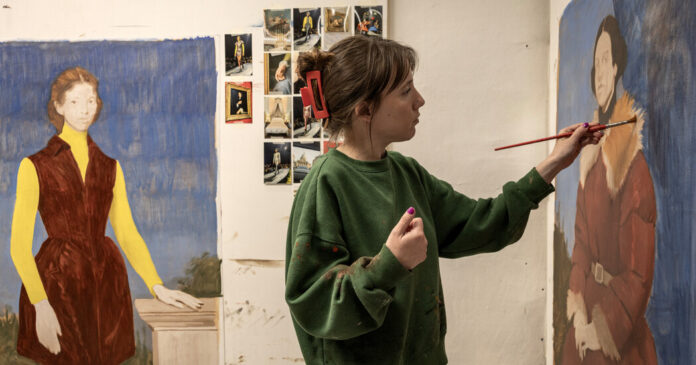

The shushing of brush strokes stopped as Nieves González, painting her latest Baroque-style portrait of a woman in a contemporary puffer jacket, paused to chitchat with a fellow artist in their studio in southern Spain.
“We’re always gossiping,” Ms. González, her green sweater splattered with paint and her face sparkling with nose studs, said with a laugh.
A good deal of the chatter in the Spanish art world lately, though, has been about Ms. González herself. Last year, the British singer Lily Allen plucked Ms. González, 29, out of the Instagram blue to paint her portrait for her latest album cover. The record, “West End Girl,” became a hit, and so did Ms. González, whom the newspaper Artnet called “an overnight art sensation.”
Her image of Ms. Allen, outfitted in a polka-dot puffer jacket, has been viewed millions of times on Spotify, billboards, even on Jimmy Fallon’s late-night desk. In March, the National Portrait Gallery in London unveiled the painting, which will hang in the same room as a work by David Hockney, and called her “one of the most compelling voices in figurative painting today.”
“My dream,” said Ms. González as she rapidly colored in the crimson puffer coat in her latest work.
Those puffer jackets are typical of Ms. González’s work, which feature ethereal or biblical muses sitting regally in natural landscapes that evoke work by the old masters.
She typically subverts that centuries-old aesthetic by dressing her subjects with sumptuous pink, blue and white quilted jackets — and also imbuing them with more agency and main character energy.
In June, she’ll show her work in Los Angeles, but collectors complain that the paintings are already all sold out. Ms. González’s Bilbao-based gallerist, Sergio García, described her trajectory as “vroom, vroom, vrooooom!”
For some, Ms. González’s rising star reflects her country’s renewed cultural vibrancy. For others, her use of contemporary puffy couture within a centuries-old Spanish Baroque aesthetic speaks to the negotiation of the past and present. For her friends, what Ms. González really screams is southern Spanish authenticity.
Energetic and garrulous, she claps with delight over her favorite Andalusian delicacies. As we walked through the streets of Granada, she seemed to know, and to talk to, everyone. She gabbed with friends on street corners, waved hello to the women in the flower shop, the nail salon, the record store.
“In one year, I’m the queen of the city,” she joked, adding that in reality she was always getting lost.
She sent kisses to her grandfather when he phoned her from back home, and she whispered “hashtag contemporary art” in front of touristy art galleries. At one point, she reassuringly called her boyfriend her “amor” — “love” — after he protested that she teased him too much about resembling a rotund friar featured in a calendar that she had hung in her studio. She said she wanted nothing more than to buy a country house with him outside their small mining hometown, Huelva.
“People ask me, ‘Well what is your goal, to become what?’” she said in her studio. “I think I’ve already achieved my goal, living off my art.”
She stepped back from her canvas to consult an image on an old laptop that she had received on her 18th birthday.
Instead of painting live models or photographs, Ms. González uses an A.I. system on that laptop to generate composite digital images. These amalgamations are drawn from a combination of baroque portraits, her own sketches and, in her most recent series, catwalk photographs from a fashion show that Hermès invited her to in Paris.
Those digital collages, which she calls “Frankensteins,” serve as the inspiration for her painted portraits.
While the models are imaginary, she said, she sometimes sees a trace of her own face in the finished portraits.
Not too long ago, she said, the idea of living off these portraits seemed impossible. “But here we are,” she said. “It’s like a dream I always had, but times 50.”
Ms. González was born and raised in a working-class family in Huelva. She started painting early in her childhood, she said, after her mother gave into her pleas and bought her a painting set themed around Vincent Van Gogh’s “Sunflowers” series.
“I don’t know why that day she said yes,” Ms. González said.
Her favorite color became yellow, “the favorite of crazies,” she said. At 17, she enrolled in the Faculty of Fine Arts at the University of Seville, the city of the artists Diego Velázquez and, for a time, Francisco de Zurbarán, both of whom influenced her greatly. She received a classical painting education and made extra money by selling her portraits to foreigners at a Seville art market and by painting caricatures of guests at weddings in Huelva.
After getting her master’s in art at Seville, she found herself working in a Huelva cosmetics store and wanted out. She had Italian friends and an ear for language, so she gave Italy a try, working as a nanny for “two demons” in the country’s north before escaping south to Aquila, where she was ultimately offered a job as a dentist’s assistant. “Me,” she said, “who knows nothing about teeth.”
She realized that if she could land a job in a foreign land and language doing something she didn’t know anything about, maybe she should return home and take a shot at doing what she did best. She gave herself a year to try becoming a painter.
Back in Huelva, she taught art classes as she worked on portraits. She sketched a copy of a Baroque master’s work in an hour for the inauguration of Huelva’s new museum. Galleries started showing her work. Her Instagram page, filled with her portraits, started gaining followers.
Last year, she moved across the region to Granada with her boyfriend, Agus Díaz Vázquez, also an artist. She usually ate lunch in the dank basement studio, heavy with the scent of paint, with her fellow artists, a jocular crew that enjoyed trouncing her in card games.
One day there, she received an unexpected message.
Leith Clark, the creative director for Ms. Allen’s album, had found Ms. González’s page. She forwarded the work to Ms. Allen, including one of a saintly figure in a blue puffer jacket holding a swan, asking what her boss thought.
“You know when you know,” said Seb Chew, Ms. Allen’s producer and close associate who was involved in the process. “Never seen anything like it before.”
Ms. Allen’s team reached out to Ms. González, without mentioning whom they worked for. But the painter was busy with work, didn’t understand what they wanted and ignored the message. Ms. Allen’s team then emphasized that they sought an album cover for a “very famous person.”
Ms. González soon connected with Ms. Allen on a video call, took the commission and hunkered down in the studio for weeks, painting to flamenco music. Ms. González said that Ms. Allen’s team had given her photographs to work from but otherwise relatively little instruction — trusting her to convey the sense of strength and independence that they were looking for.
Using that creative license, Ms. González outfitted Ms. Allen in a polka-dot puffer that the musician, in reality, had never worn. Once the album came out, it soon made headlines for lyrics that, the singer has said, are laced with details about her split from the American actor David Harbour.
The publicity also paid off for Ms. González.
Soon, her friends in the studio started poking fun at her resident celebrity status. They began teasing Ms. González by referring to her as Britney Spears. “Oh Britney,” one colleague said whenever Ms. González complained about all of the new demands on her time.
Ms. González did not meet the actual pop star, Ms. Allen, in person until last month at the portrait’s official unveiling in London. They hit it off, Ms. González said, but this time, she held her tongue.
“Can you imagine,” she said, her eyes widening at the possibility, “gossiping with her?”
Carlos Barragán contributed reporting.