

New Delhi:
At the end of a two-day foreign ministers’ meeting in New Delhi, marking the BRICS’ 20th anniversary, issued a sweeping statement condemning Israeli military operations, unilateral tariffs, and cross-border terrorism while pushing back against what members called deliberate attempts to undermine the UN system.
The statement called for an immediate and unconditional ceasefire in Gaza, condemned rising global trade protectionism, and reaffirmed the bloc’s ambition to reshape the architecture of international governance in favour of the developing world.
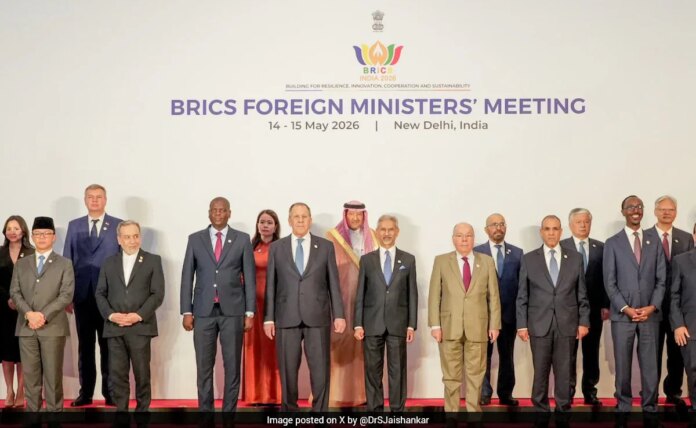
The meeting, hosted by India as the 2026 BRICS chair, brought together the foreign ministers of all ten member states. The outcome statement, stretching across more than 60 paragraphs, touched everything from artificial intelligence and climate finance to outer space governance. But the political heat was concentrated around West Asia, terrorism, trade tensions and the future of the United Nations.
Gaza And The Middle East
On the question that has dominated global diplomacy for over a year, the BRICS ministers pulled few punches. The group called on all parties to agree to “an immediate, permanent and unconditional ceasefire” in Gaza, and demanded the full withdrawal of Israeli forces from the Gaza Strip and all other parts of the Occupied Palestinian Territory. The statement also called for the release of all hostages and detainees held in violation of international law, and for “sustained and unhindered” humanitarian access to the territory.
The statement said, “There were differing views among some members as regard to the situation in the West Asia/Middle East region. BRICS members expressed their respective national positions & shared a range of perspectives”.
The ministers condemned the use of starvation as a method of warfare and “attempts to politicize or militarize humanitarian assistance” – language widely understood as directed at Israel and its backers. They also strongly reaffirmed their support for UNRWA, the UN agency for Palestinian refugees whose mandate has come under pressure, and noted the International Court of Justice’s provisional measures affirming Israel’s legal obligation to allow aid into Gaza.
On the broader political question, the statement reiterated BRICS support for a fully sovereign and independent Palestinian state within the 1967 borders, with East Jerusalem as its capital, and backed Palestine’s full membership in the United Nations. The ministers also called for Israel to withdraw from all Lebanese territory and to respect the terms of the ceasefire agreement with Beirut, condemning what they described as continued violations of Lebanese sovereignty.
On Yemen, the group stressed the importance of navigational freedoms through the Red Sea and Bab Al-Mandab Strait and backed UN-led peace efforts – though the statement noted that one member entered reservations on aspects of that paragraph, a signal of continuing differences within the bloc on the Houthi question.
Terrorism And Jammu & Kashmir
In a section that will be closely read in South Asia, the ministers “condemned in the strongest terms” the terrorist attack in Jammu and Kashmir on April 22, 2025, in which 26 people were killed. The inclusion of the condemnation – with India holding the chairship – reflects New Delhi’s success in securing explicit multilateral endorsement for its position on cross-border terrorism at a moment of acute tension with Pakistan.
The statement reaffirmed that terrorism “should not be associated with any religion, nationality, civilization or ethnic group,” while simultaneously calling for zero tolerance, accountability for all those involved in terrorist activities, and an end to safe havens and terrorist financing. The ministers also called for the early conclusion of a Comprehensive Convention on International Terrorism at the United Nations – a treaty India has long championed.
Trade Wars And Economic Pressure
With global trade rattled by a fresh wave of tariff escalation, the BRICS statement offered some of its most pointed language on economic policy. The ministers voiced “serious concerns about the rise of unilateral tariff and non-tariff measures which distort trade and are inconsistent with WTO rules,” and warned that such actions threaten to disrupt global supply chains, reduce trade flows, and worsen inequality between nations.
In a notable development, China announced at the meeting that it would no longer seek special and differential treatment in current and future WTO negotiations – a significant concession by Beijing that could reshape multilateral trade talks and potentially ease some Western complaints about China’s position in the global trading system.
The group also condemned unilateral economic sanctions and secondary sanctions as contrary to international law, arguing they disproportionately harm civilian populations and deepen the digital divide. In a pointed aside, ministers “deplored attempts, including by deliberately withholding assessed contributions, to unilaterally undermine the work of global multilateral institutions” – a direct reference to funding freezes that have strained the UN and affiliated agencies.
Push To Reform Global Governance
The ministers renewed their call for comprehensive reform of the UN Security Council, urging greater representation for Africa, Asia, and Latin America. China and Russia – both permanent Security Council members – reiterated their support for India and Brazil playing a greater role in the UN, including on the Council.
On the UN Secretary-General selection, the ministers noted pointedly that only one Latin American national has ever held the post and no woman has ever been elected to the role.
AI, Climate And What Comes Next
The statement welcomed India’s AI Impact Summit held in February 2026 and committed BRICS members to implementing their joint statement on global AI governance. On climate, the group backed Ethiopia’s hosting of COP32 and reiterated commitments to the Paris Agreement, while calling for developed countries to provide adequate financial and technology support to developing nations.
As the meeting closed, ministers expressed full support for the upcoming XVIII BRICS Summit in New Delhi later this year, with China set to assume the 2027 chairship.