
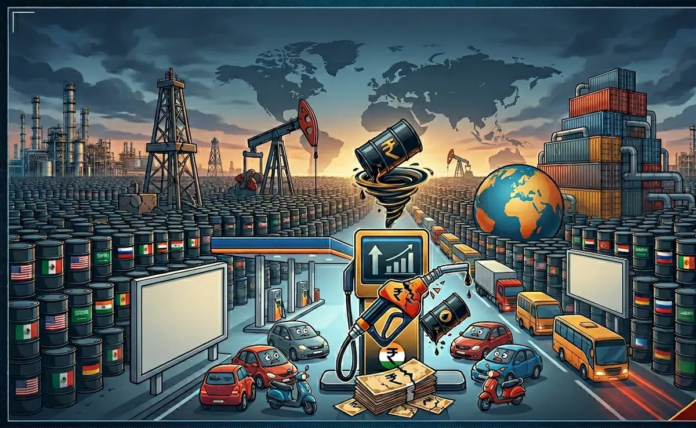

Petrol, Diesel Price Hike: As petrol and diesel prices went up by Rs 3 per litre on May 15, many Indians felt the pinch. The Rs 3 hike is the first revision in almost four years.
However, it is the smallest price increase among major economies. Since the Iran war disrupted the Strait of Hormuz, the world’s most critical oil route, fuel prices have surged across countries. Many governments passed on the full impact to consumers within days.
India did not.
For nearly 76 days, public sector oil companies held prices steady, even as crude oil crossed $100 per barrel. Losses piled up. Under-recoveries touched around Rs 1,000 crore every day.
While several nations adjusted prices by 20, 40, even 90 per cent, India absorbed the shock for over two months.
Fuel Price Hike: Why India Did Not Pass On The Full Increase
Government sources say this is a conscious choice. India imports 80-85 per cent of its crude oil. Every $10 rise in crude adds $13-14 billion to the import bill.
India’s annual crude import bill is already estimated at Rs 12-15 lakh crore. On top of that, gold imports have surged to nearly Rs 6 lakh crore. Together, oil and gold are causing what officials call a “massive twin drain” on foreign exchange.
Despite this, the Centre had earlier cut excise duty by Rs 8 on petrol and Rs 6 on diesel to protect consumers.
As of Friday (May 15), petrol under-recovery is estimated at Rs 26 per litre. Diesel under-recovery is nearly Rs 82 per litre. Instead of passing this on, oil companies and the government are absorbing losses close to Rs 1,000 crore daily.
Why A Full Pass-Through Would Hurt The Poorest The Most
Fuel demand in India is largely price inelastic. People cannot easily cut usage. Farmers need diesel for pumps. Truckers need it for transport. Auto drivers need it to earn daily income.
Officials estimate that a full pass-through of global prices could have required fuel price hikes of 200-300 per cent.
That would have hit the bottom 20 per cent of the population the hardest. So the government chose a different path – reduce volumes, not shock consumers with prices.
Not A Domestic Crisis
The current hike is an outcome of the “external geopolitical shock”. The trigger was the US-Iran conflict and the disruption of shipments through the Strait of Hormuz. India has no control over this.
Yet, key macro indicators remain far stronger than past crises.
- Current Account Deficit below 1.5% (vs nearly 5% in 2012-13)
- Inflation relatively controlled despite global volatility
The government is drawing a sharp distinction between this phase and earlier economic crises. Instead of rationing or coercive controls, the Prime Minister has asked for voluntary restraint.
- Reduce fuel consumption
- Avoid buying gold for a year
- Cut non-essential foreign travel
Why? Because gold is now India’s second-largest import at nearly $72 billion. Indian households are estimated to hold 30,000 tonnes of gold worth almost $5 trillion.
Outbound tourism costs $28-30 billion annually. Similarly, halving gold imports alone could significantly reduce pressure on the Current Account Deficit.
Officials describe this as the “softest dollar-saving lever” with the least economic damage.
The same strategy is visible in fertilisers. A Rs 2,200 fertiliser bag is still being sold to farmers for Rs 242 because of a Rs 2.25 lakh crore subsidy. The push towards Nano Urea and domestic alternatives is now being seen as both economic and strategic.
India Chose Voluntary Conservation Over Rationing
Around 82 countries have imposed emergency restrictions, rationing, or sharp price hikes. India has done none of this.
Shipping costs through Hormuz have reportedly surged to $2 million per voyage. Yet, the approach here is persuasion, not panic. Officials describe it as a refusal to be “extorted” by a geopolitical chokepoint.
After 76 days of complete absorption, the Rs 3 increase restores only a small cost signal at the pump.
Globally, countries adjusted in weeks. India waited months. In percentage terms, this is a 3-3.5 per cent increase on a base of about Rs 95 per litre — the lowest among major economies.