
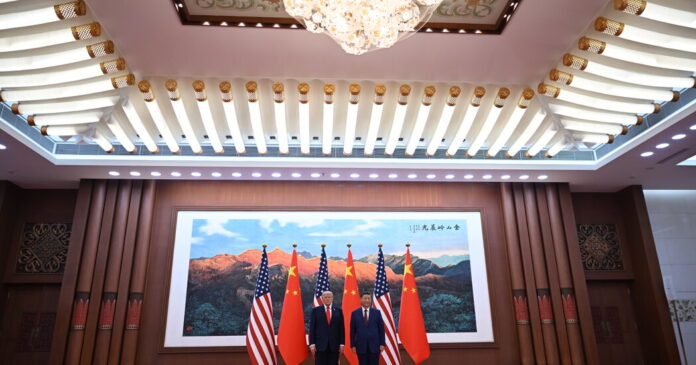

President Trump’s meticulously choreographed visit to China are taking him to some of the country’s most politically and historically significant landmarks as he meets with China’s leader, Xi Jinping.
A welcome ceremony was held at the Great Hall of the People on Thursday morning. In the afternoon, Mr. Trump visited the Temple of Heaven.
The symbolic significance of each place was likely an important consideration in Chinese officials’ planning, said Han Lin, a Shanghai-based analyst at the Asia Group, an advisory firm. Each landmark represents a chapter in Beijing’s evolution as China’s capital for most of the past 800 years, from imperial rule to modern Communist governance.
Here is what to know about the places visited by Mr. Trump in Beijing:
Great Hall of the People
This imposing building on Tiananmen Square, completed in 1959, is a familiar backdrop for state visits. World leaders have been photographed outside on red carpets, and inside meeting with Mr. Xi and other Chinese officials.
The Chinese Communist Party, which took power in 1949, commissioned the hall less than a decade later as a monument to the new state. Zhou Enlai, China’s premier under Mao Zedong, said the building should embody the principle that “the people are the masters of the country.”
The building is roughly the size of 24 soccer fields and has about 300 meeting rooms. It features an auditorium with 10,000 seats and a distinctive red star on the ceiling surrounded by lights resembling a galaxy, symbolizing the unity of the Chinese people around the Communist Party.
Today, the Great Hall serves as the meeting place for annual sessions of the National People’s Congress, China’s legislature, as well as diplomatic ceremonies and Communist Party events.
Temple of Heaven
A short drive from Tiananmen Square, the Temple of Heaven is perhaps the most famous temple in the city. The original structure was built in the early 1400s during the Ming dynasty, along with the Forbidden City, the royal palace complex that Mr. Trump and Mr. Xi toured with their spouses during their last meeting in Beijing in 2017.
During the Ming and Qing dynasties, emperors visited the temple to perform rituals for good harvests and favorable weather. The ceremonies reflected the belief that Chinese rulers governed with a divine mandate.
Like the Forbidden City, the temple represents the long history of China’s civilization. During Mr. Trump’s last visit to Beijing, Mr. Xi highlighted that history while guiding him through the palace.
“Beijing will likely contrast its long-term planning approach with Washington’s election-driven political swings,” Mr. Lin said. “They want to emphasize themes like continuity, economic openness and global stability — things befitting a civilization of China’s long history.”
The temple, which became a public park in 1918, is a popular stop for tourists. While several U.S. presidents have visited landmarks such as the Forbidden City and Great Wall, the Temple of Heaven has appeared less frequently on presidential itineraries. Gerald R. Ford visited it during a 1975 trip to China.