

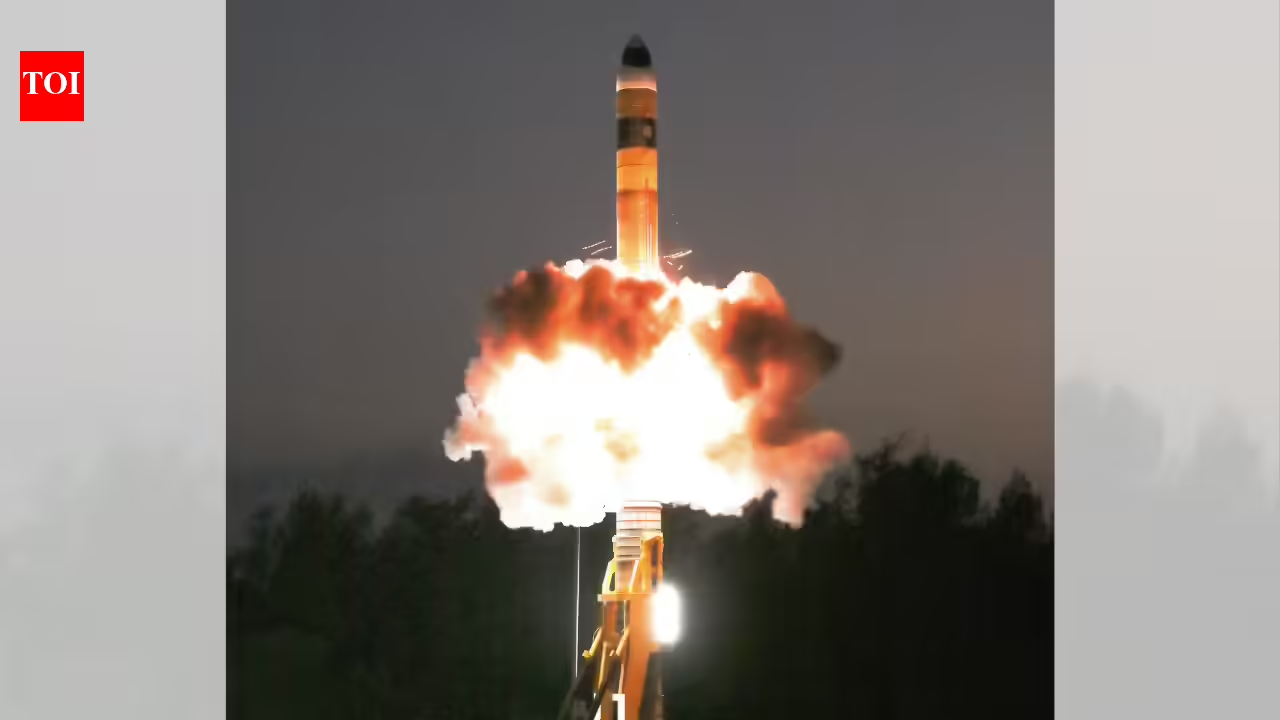
NEW DELHI: PM Narendra Modi on Wednesday said the Pokhran II nuclear tests showcased that “no power can bend India”.Codenamed ‘Operation Shakti’, Pokhran II tests were a series of five nuclear bomb explosions in May 1998 that gave India official entry into the global “nuclear club” and the sixth country to declare itself a nuclear-armed nation. The nuclear tests were conducted over two days in 1998: May 11 (three tests) and May 13 (two tests).On the Pokhran II anniversary, Modi in a post on X said, “On this very day in 1998, the nuclear tests conducted by India demonstrated to the world just how unwavering our nation’s resolve is! After the May 11 tests, the entire world brought pressure to bear on India, but we demonstrated that no power can bend India. And interdependence of power and the powerful is established. There is no power without Shiva, nor Shiva without power.”India increased its nuclear warhead count from 172 in 2024 to 180 by early 2025 (slightly more than Pakistan’s 170 nukes), and estimations indicate further growth to 190 by 2026, according to a SIPRI 2025 report. “India continued to develop new types of nuclear delivery systems. India’s new ‘canisterised’ missiles, which can be transported with mated warheads, may be capable of carrying nuclear warheads during peacetime, and possibly even multiple warheads on each missile, once they become operational,” the report said.India has been upgrading its nuclear delivery systems and actively maturing its nuclear triad — land, air and sea capabilities — with a focus on achieving a “credible minimum deterrence” and an assured second-strike capability. On May 8 this year, India successfully flight-tested an advanced Agni missile equipped with MIRV capability, enabling a single missile to carry multiple nuclear warheads.The Indian Air Force (IAF), on its part, has also significantly enhanced the aerial component of its nuclear triad, moving towards a more diversified and capable fleet to ensure robust deterrence. While older, battle-proven platforms like Jaguar fighter jets and Mirage 2000 remain in service, the integration of advanced, multi-role fighters like Rafales and Sukhois is key to this strategic shift.India has also expanded its Arihant-class submarine programme to four nuclear-powered ballistic missile submarines (SSBNs) as part of the advanced technology Vessel (ATV) project, aiming to ensure a survivable second-strike capability. INS Arihant, INS Arighaat and INS Aridhaman carrying nuclear-capable K-15 and K-4 missiles have already been commissioned into the Navy. The fourth submarine is in the making and will be commissioned in near future.
Pokhran II tests showcased that ‘no power can bend India’, says Modi; Country has increased its N-warhead count from 172 in 2024 to 180 in 2025, says report | India News
Published: