

The United States could end the month-old cease-fire and resume its attacks on Iran, President Trump and Defense Secretary Pete Hegseth said on Tuesday, a day after Mr. Trump dismissed Tehran’s latest offer to end the war as “garbage.”
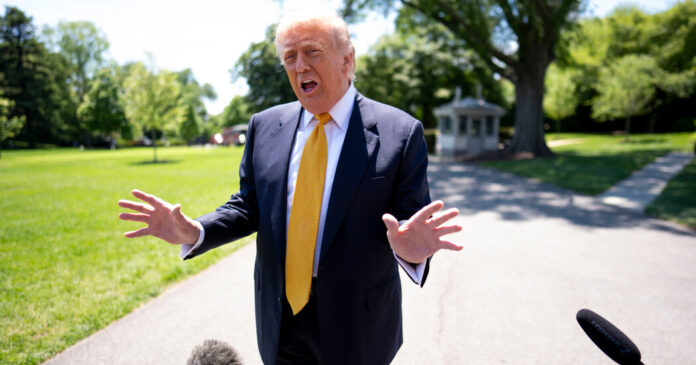
“We’re either going to make a deal or they’re going to be decimated,” Mr. Trump told reporters in Washington as he prepared to travel to Beijing for a summit with China’s top leader, Xi Jinping. “One way or the other, we win.”
Mr. Hegseth told a congressional hearing: “We have a plan to escalate, if necessary. We have a plan to retrograde, if necessary. We have a plan to shift assets.” He declined to provide details, saying it would not be appropriate in a nonclassified hearing.
Iran’s demands to end the war included U.S. war reparations, recognition of Iranian sovereignty over the Strait of Hormuz and the end of American sanctions, the state broadcaster reported on Monday.
Mr. Trump dismissed that position and said the truce was “on massive life support.” Paying reparations and recognizing Iranian control of the strait would almost certainly be non-starters for the Trump administration, analysts said. Ending sanctions would be on the table only if Iran were willing to make major concessions on its nuclear program, they added.
With the truce on shaky ground, both sides seemed to be raising the stakes on Tuesday.
A spokesman for the Iranian Parliament’s national security committee, Ebrahim Rezaei, warned that Iran could enrich uranium to 90 percent purity, a level considered weapons grade, if it were attacked again. It was unclear how seriously Iran was considering such a move or how capable it was after the strikes on its nuclear sites, and Mr. Rezaei said only that Parliament could review the option.
Mr. Trump, speaking outside the White House on Tuesday, dismissed questions about high food and gas prices stemming from Iran’s closure of the strait, which contributed to overall inflation rising to 3.8 percent in April. The president said that Americans supported his goal of ensuring that Iran could not develop a nuclear weapon, and he said — as he has repeatedly — that the war would end and the strait would reopen soon.
“As soon as this war is over, which will not be long, you’re going to see oil prices drop,” he said.
Iran appears to be betting that economic pain stemming from a closed strait will force Mr. Trump to make concessions. The U.S. Labor Department reported on Tuesday that consumer prices rose last month at the fastest rate since May 2023, driven by high energy prices.
At the congressional hearing with Mr. Hegseth, the Pentagon’s comptroller, Jules W. Hurst III, said that the war, which began when the United States and Israel started bombing Iran on Feb. 28, had cost $29 billion so far. That is an increase from the $25 billion figure that Mr. Hurst provided at a hearing two weeks ago.
He attributed the rising cost to the “repair and replacement of equipment” and “general operational costs,” but said it did not include the cost of repairing more than a dozen American military bases damaged by Iranian missiles and drones.
“We don’t know how those bases would be reconstructed,” Mr. Hurst testified, adding, “We just don’t have a good estimate at this time.”
The war has forced the Pentagon to rush bombs, missiles and other hardware to the Middle East from commands in Asia and Europe. The drawdowns have left these regional commands less ready to confront potential adversaries like Russia and China, and they have forced the United States to find ways to scale up production to address the depletions, Trump administration and congressional officials have said.
At the hearing on Tuesday, Gen. Dan Caine, chairman of the Joint Chiefs of Staff, sought to allay concerns that the war had drained the U.S. military’s global supply of munitions.
“We have sufficient munitions for what we’re tasked to do right now,” he said, citing what he said top commanders around the world had told him.