
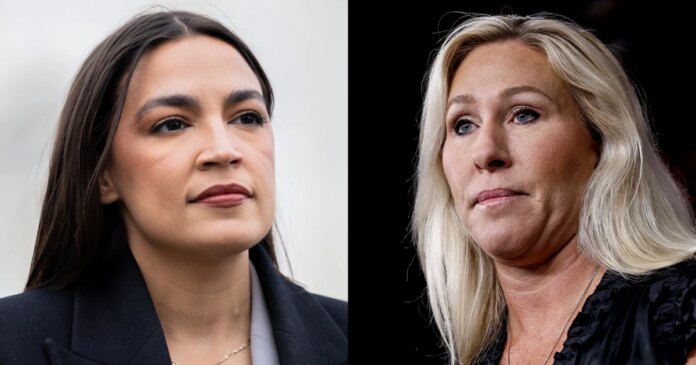
When Rep. Alexandria Ocasio-Cortez singled out former Rep. Marjorie Taylor Greene as an “antisemite” and a “bigot” in public remarks Friday, she rattled more than a few cages.
Subscribe to read this story ad-free
Get unlimited access to ad-free articles and exclusive content.


One of those was Greene herself, who charged Monday that Ocasio-Cortez, D-N.Y., was “very hypocritical” to attack her.
“I’m not a bigot. I’m not an antisemite,” Greene, a Republican from Georgia, said in an interview. “I just think the U.S. should not fund Israel.”
In a conversation Friday at the University of Chicago Institute of Politics moderated by David Axelrod, the onetime political strategist to President Barack Obama, a student asked Ocasio-Cortez whether she stood by past remarks that there were “legitimate white supremacist sympathizers at the core of the House of Representatives caucus” and, if so, why she worked with some of them.
Ocasio-Cortez did stand by them and said she wasn’t scared of reaching across the aisle, holding up her work with Rep. Tim Burchett, R-Tenn.
But she set a clear boundary.
“I personally do not trust someone like Marjorie Taylor Greene, a proven bigot and antisemite, on the issue of what is good for Gazans and Israelis,” Ocasio-Cortez said. “I don’t think it benefits our movement in that instance to align the left with white nationalists. I don’t think it serves us.”
The remarks drew criticism from some on the left, including Ryan Grim, editor of Drop Site News, who praised Greene for having “sacrificed her political career to stand against genocide, against Trump and against the Epstein class.”
That the left flank came to Greene’s defense highlights how muddled politics on both sides of the aisle have become 17 months into President Donald Trump’s second term in office. It also brought into clearer view the distinctions that Ocasio-Cortez and Greene — both potential 2028 candidates — would make should they run for the White House.
Significantly, Ocasio-Cortez signaled she wouldn’t follow the politics of Rep. Ro Khanna, D-Calif., who is, at least for now, in the closest competition with her for support from the massive grassroots movement behind Sen. Bernie Sanders’ two runs for president.
Khanna is also on the short list for a 2028 run for president. Khanna has notched significant legislative wins by partnering with Republicans, specifically Greene, including forcing a vote to release the Jeffrey Epstein files.
“I was raised with Midwestern values in Bucks, Pennsylvania, where we extended grace to our neighbors. I guess I still believe in trying to find common ground where possible as Americans to keep us out of foreign wars and hold the Epstein class accountable,” Khanna told NBC News on Monday. “We can do this while being uncompromising in our commitment to multiracial democracy.”

Greene once posted a photo on Facebook of herself holding a gun alongside images of Ocasio-Cortez and Reps. Ilhan Omar, D-Minn., and Rashida Tlaib, D-Mich., encouraging “strong conservative Christians to go on the offense against these socialists who rip our country apart.” She has used terms like “the jihad squad” and “Hamas Caucus” in reference to Ocasio-Cortez and her allies who long have been targets of death threats.
Asked whether she regretted or would apologize for past remarks about Ocasio-Cortez, including standing outside her office door with cameras, taunting her, Greene said, “I’ve already said publicly that I don’t participate in toxic politics anymore.”
In 2023, House Democrats explored censuring Greene for a lengthy history of offensive actions and rhetoric and even pondered removing her from Congress after, among other things, she said Muslims shouldn’t serve in government, denied that a plane hit the Pentagon during the Sept. 11 terrorist attacks and amplified false rhetoric that the school shooting in Parkland, Florida, in 2018 was a false-flag operation to advance gun control.
By drawing the line, Ocasio-Cortez signaled to her supporters that she wasn’t interested in allowing shared grievances to erase someone’s record. In the 2024 election, some Democrats were angered by former Vice President Kamala Harris’ campaign events with Liz Cheney, a former Republican congresswoman who became a staunch Trump critic and served on the committee examining the Jan. 6, 2021, attack on the U.S. Capitol.
Sanders himself praised Greene as one of the “good Republicans” after she broke with Trump last year and said she was siding with her constituency. She resigned from Congress in January.
Ocasio-Cortez stressed looking at Greene’s full record, saying it was now politically tenable to break with Trump on major issues like funding Israel.
Greene, though, pointed to those on the left who criticized Ocasio-Cortez for her comments, adding that it was positive for the left and the right to work together when they agree on such populist or “America First” issues.
“It’s very good for the country,” she said.
One progressive group, Our Revolution, didn’t take sides in the debate, but it said that while Democrats are in the minority, they may have to forge unlikely ties.
“In a political environment this polarized, there are moments where issue-based coalition building can be effective, particularly around anti-corruption, monopoly power, endless war, or challenging entrenched elites,” Executive Director Joseph Geevarghese said in a statement. “That doesn’t mean progressives abandon their values or suddenly agree on broader ideology. But there is growing recognition across parts of the populist left and right that concentrated wealth and corporate power have too much influence over our political economy.”