
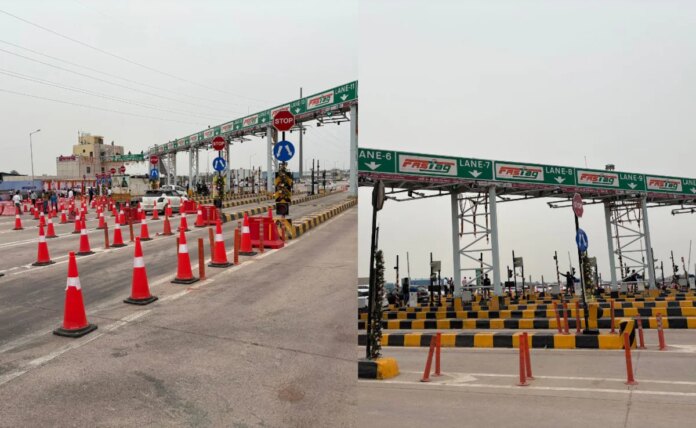

Long queues at toll plazas, mandatory stops at barriers, and traffic jams caused by toll collection may soon become a thing of the past. Delhi-NCR has launched its first barrier-less tolling system, inaugurated by Union Road Transport and Highways Minister Nitin Gadkari.
The new Multi-Lane Free Flow (MLFF) tolling system has been introduced at the Mundka-Bakkarwala toll plaza on UER-II (Urban Extension Road-II). The technology allows vehicles to pass through toll lanes without stopping, reducing congestion, saving fuel, and minimising disputes often seen at toll booths.
How Does The Technology Work?
The MLFF system eliminates the need for barriers, toll booths, and even toll operators. Each lane is equipped with three cameras that identify vehicle number plates. The Automatic Number Plate Recognition (ANPR) cameras detect the vehicle registration number and send the information to the FASTag-reading technology installed on the lane.
Once verified, the toll amount is automatically deducted from the FASTag account linked to the vehicle. Drivers no longer need to stop near scanners or slow down to ensure FASTag detection. The cameras can identify moving vehicles and process payments seamlessly.
What Happens If There Is No FASTag Balance?
Vehicles without sufficient FASTag balance or those not equipped with FASTag will still be detected through ANPR cameras. An e-notice will then be sent to the vehicle owner asking them to pay the toll amount.
If the toll is not paid within 72 hours, a penalty of one-and-a-half times the toll amount will be imposed. Repeated violations may lead to FASTag suspension, cancellation of the driving licence, and even seizure of the vehicle by police authorities.
Nationwide Rollout Planned
According to Minister Nitin Gadkari, India currently has over 1,300 toll plazas on National Highways. The government believes the MLFF technology can help save nearly Rs 7,000 crore annually, along with fuel worth Rs 285 crore, while also reducing carbon emissions significantly.
The minister said around 18,000 challans are already being generated at the toll plaza under the new system. He added that the government’s broader aim is to improve road discipline and reduce accidents by ensuring better compliance with traffic rules.
Cash payments at toll plazas across the country have already been discontinued since April 1, while the number of annual toll passes has crossed 60 lakh.
What Are Commuters Saying?
The new toll system became operational at midnight at the Mundka-Bakkarwala toll plaza. Neeraj, a commuter travelling from Gurugram to Delhi, welcomed the move and said the system would benefit both the government and the public.
He said traffic congestion during evening hours is a common problem at the toll plaza, and the new technology would help save both time and fuel.
Another commuter also praised the initiative and said such technology should be implemented nationwide to provide relief to motorists across the country.