

New Delhi:
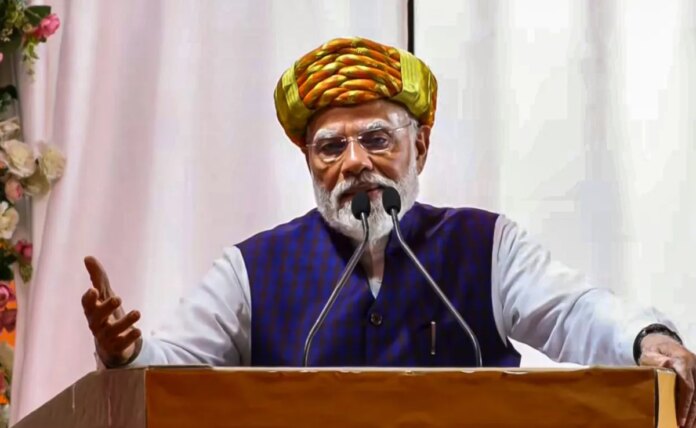
Prime Minister Narendra Modi arrived in Gujarat on Sunday following a whirlwind tour of Karnataka and Telangana, delivering a sharp speech in Jamnagar that balanced local pride with a scathing critique of the political climate in West Bengal. He said the polls in Bengal “are like nowhere else” and that the BJP will bring change in the state.
Addressing a massive gathering, the Prime Minister expressed his gratitude for the “increasing blessings” of the electorate, noting that the BJP has now secured the loyalty of four consecutive generations in Gujarat. He highlighted the state’s evolution into a global industrial hub, citing its leadership in semiconductor manufacturing, metro coach production, and aerospace.
“Gujarat is not just leading in industry; we are the only state with a dedicated Ministry for Climate Change,” the PM remarked, pivoting from the state’s economic prowess to its cultural and historical significance.
Also read: WFH, No Foreign Weddings: PM Modi’s Strategy To Combat Rising Prices
The “Deep Pit” of Bengal Politics
While the crowd was local, the Prime Minister’s narrative shifted sharply toward the eastern front. He described the state’s political landscape as uniquely perilous.
“Elections in Bengal are like nowhere else in the country,” PM Modi stated. “The entire nation is waiting for the BJP to bring change there. Imagine the suffering of the people where over 300 of our workers have had to sacrifice their lives,” he added.
He further characterised the current state of Bengal as being in a “deep pit,” vowing that the BJP is the only force capable of restoring its glory.
Also read: PM Modi’s ‘Stabs Own Leaders In Back’ Jibe At Congress Over Kerala Indecision
A Call to Remember: Somnath and the Spirit of 1857
The Prime Minister’s visit coincides with significant historical milestones. He reminded the audience that May 10 marks the anniversary of the 1857 Revolution, the First War of Independence.
Looking ahead to his schedule, the PM confirmed he will be in Somnath to commemorate the historical resilience of the temple.
“We must remember the destruction of 1857, but we must also remember the sacrifice and valour,” he said.
He invoked the legacy of Sardar Vallabhbhai Patel and India’s first President, Dr Rajendra Prasad, noting that the restoration of Somnath was a dream realised through the suffering and bravery of many “veers” (heroes) of the past.