
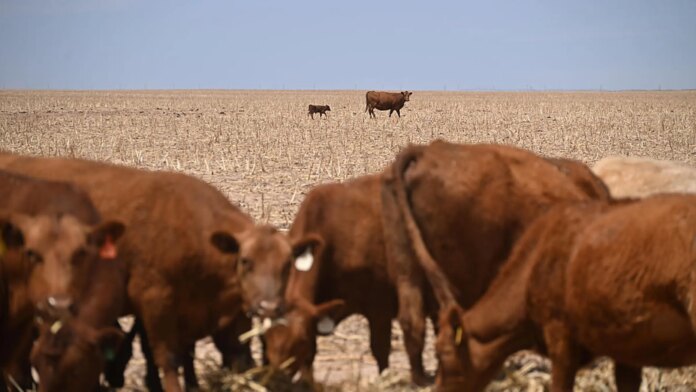

The United States experienced its worst spring drought on record last month, with more than 60% of land in the lower 48 states experiencing moderate drought or worse.
The drought has sparked alarm among farmers and environmentalists across the country, who warn that food supplies may be impacted and wildfires may blight areas where they are not usually seen.
The dry conditions are concentrated in the southeast, where moderate to exceptional drought covered 99.81% of the region at its peak in April, according to the U.S. Drought Monitor. Severe to exceptional drought covered more than 80% of the region, the highest level in April since the monitor began collecting data in 2000.
The drought has been building for some time. Georgia, North Carolina and South Carolina experienced record dry conditions between September 2025 and March 2026, with records dating back to 1895.
While heavy rainfall in the South last week eased conditions in the Deep South and Texas, the U.S. Drought Monitor said that “drought conditions remained mostly unchanged across southeastern Alabama, Georgia and northwestern Florida, where soil moisture and streamflows remain extremely low.”
The National Oceanic and Atmospheric Administration (NOAA) found that January through March was the driest on record for the continental U.S., with precipitation overall less than 70% of average, and these dry conditions have expanded to nearly the largest extent of drought since November 2022.
Major crops at risk
The drought is threatening to have a severe impact on major agricultural crops, from wheat farmers in Kansas to vegetable farmers in Georgia.
The poor conditions and low yields come at a time when farmers are already struggling due to tariffs and the rising cost of fertilizer resulting from the war in Iran.
“We had to stop planting because it’s so dry,” Bain said, adding that the costs of his farm have gone up in the wake of the fuel crisis sparked by the Iran war. “It’s very costly per day, especially when you are looking at diesel fuel prices at $4 for off-road, over $5 on road, so just another cost when you have dry weather.”
For wheat farmers across the Great Plains, those late April to early May weeks are critical as winter wheat begins to mature before the summer harvest. Yet, the U.S. Department of Agriculture (USDA) forecast that this year’s wheat acreage will be the lowest since 1919.
Rachel Cleetus, senior policy director with the Climate and Energy Program at the Union of Concerned Scientists, wrote last week that climate change was “fundamentally altering conditions for U.S. agriculture, creating unprecedented risks and uncertainties for livelihoods of farmers and ranchers.”
Those conditions could raise food prices for consumers, she added.
Wildfires in the wetlands
The dry conditions have also fueled wildfires, even in wetland environments like the South Florida Everglades. These wildfires have already burned 120,000 acres of land in Florida this year, and according to NASA, the “current drought is the most widespread and severe to affect the state since 2012.”
“Florida has got one of the worst fire seasons in maybe the last 30 or 40 years, or it’s turning out to be that way,” Florida Agriculture Commissioner Wilton Simpson told CBS in late April.
In Georgia, Gov. Brian Kemp declared a state of emergency in 91 counties in late April as wildfires burned across the southeast of the state, allowing the state National Guard to respond to affected areas. The Georgia Forestry Commission (GFC) responded to zero new wildfires in the state on May 7—the first day with no new fires in the state since December 2025.