
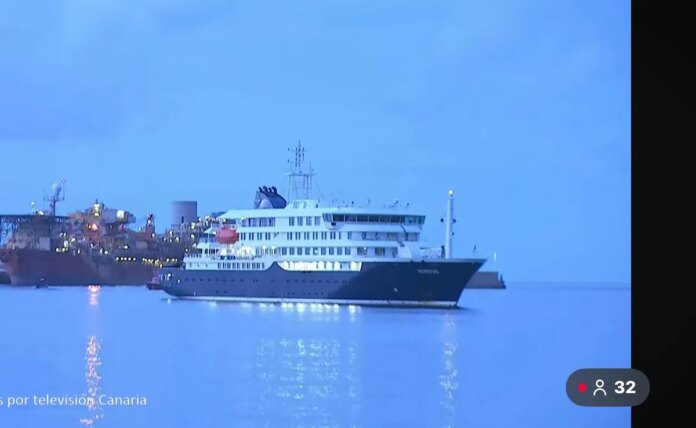

The Dutch-flagged expedition vessel MV Hondius, which became the centre of a global hantavirus outbreak investigation after multiple deaths onboard, has now arrived off Spain’s Canary Islands. The Embassy of India in Madrid confirmed that the two Indian nationals aboard the ship are “healthy and asymptomatic”.
The vessel, carrying around 150 passengers and crew members, anchored near Tenerife under strict international public health protocols after cases linked to the Andes strain of hantavirus triggered international concern. Spanish authorities, the World Health Organization (WHO), and health agencies across multiple countries coordinated passenger disembarkation and medical monitoring operations.
LIVE from Tenerife: Media briefing on disembarkation of passengers and crew from MV Hondius. #hantavirus https://t.co/ImO8uMtiWp
— World Health Organization (WHO) (@WHO) May 10, 2026
The outbreak has attracted widespread attention because the Andes strain is the only known hantavirus capable of limited human-to-human transmission. However, WHO officials and global experts have repeatedly stressed that the outbreak is not comparable to Covid-19 and that the overall public health risk remains low. Earlier reports revealed that the outbreak onboard had been linked to at least six confirmed infections and three deaths, prompting enhanced surveillance and contact tracing efforts across several countries.
Indian Nationals Onboard Are Safe
In its latest statement, the Embassy of India in Madrid confirmed that the two Indian nationals onboard the MV Hondius are healthy and have shown no symptoms linked to hantavirus infection.
The embassy said the passengers disembarked according to protocols established by Spanish authorities and WHO guidance after the vessel anchored off the Canary Islands.
The reassurance comes amid heightened global attention on the ship after several passengers reportedly developed severe respiratory illness during the voyage that began in Argentina.
The disembarkment of the first group of MV Hondius passengers has started. @WHO experts on the ground are working with the Spanish Health Ministry on the epidemiological assessment of the passengers and coordinating charter flights with the Interior Ministry. This collaboration… pic.twitter.com/Is0qFRer5k
— Tedros Adhanom Ghebreyesus (@DrTedros) May 10, 2026
WHO Chief: “This Is Not Another Covid”
WHO Director-General Dr. Tedros Adhanom Ghebreyesus personally addressed residents of Tenerife ahead of the ship’s arrival to calm fears surrounding the outbreak.
“I need you to hear me clearly: this is not another COVID,” Dr. Tedros said in a public message released by the WHO. He stressed that the current public health risk from hantavirus “remains low” and said the virus spreads very differently from coronavirus.
WHO officials explained that although the Andes strain can spread between humans in rare circumstances, transmission generally requires prolonged close contact, particularly among family members, intimate partners or caregivers. Unlike Covid-19, it does not spread efficiently through casual airborne exposure.
Dr. Maria Van Kerkhove, WHO’s acting director for epidemic and pandemic management, also emphasised that hantavirus outbreaks are usually contained through traditional public health measures such as contact tracing, isolation and symptom monitoring.
The disembarkment of the first group of MV Hondius passengers has started. @WHO experts on the ground are working with the Spanish Health Ministry on the epidemiological assessment of the passengers and coordinating charter flights with the Interior Ministry. This collaboration… pic.twitter.com/Is0qFRer5k
— Tedros Adhanom Ghebreyesus (@DrTedros) May 10, 2026
Dr Soumya Swaminathan: “Outbreak Can Be Contained”
Former WHO Chief Scientist Dr. Soumya Swaminathan said the outbreak aboard the MV Hondius was concerning but manageable. Dr. Swaminathan explained that the Andes strain‘s limited human-to-human transmission does not make it comparable to highly infectious respiratory viruses like SARS-CoV-2.
She noted that outbreaks linked to hantavirus are generally localised and can be contained effectively if public health protocols are implemented quickly. According to her, measures such as isolation, monitoring close contacts and rapid medical response are usually enough to interrupt transmission chains.
She also stressed that scientists already understand hantaviruses far better than they understood Covid-19 in early 2020, making containment strategies more effective.
Also Read: “Outbreak Can Be Contained”: Dr Soumya Swaminathan On Hantavirus Crisis
International Monitoring Continues
WHO officials have said additional cases could still emerge because the incubation period for Andes hantavirus may extend up to six weeks. However, authorities continue to describe the outbreak as limited and manageable.
Passengers onboard the MV Hondius underwent medical screening, symptom monitoring and controlled disembarkation procedures coordinated by Spain and international health agencies. WHO experts, along with specialists from European public health bodies, have remained involved in containment operations.
The safe arrival of the MV Hondius in Spain and confirmation that the two Indian nationals onboard remain healthy have brought some reassurance amid the international hantavirus scare. While the outbreak has raised concerns because of the rare Andes strain involved, WHO officials and Indian experts continue to emphasise that this is not “another Covid” and that the overall public health threat remains low. Authorities across multiple countries are continuing surveillance, contact tracing and precautionary health monitoring to prevent further spread.
Disclaimer: This content including advice provides generic information only. It is in no way a substitute for a qualified medical opinion. Always consult a specialist or your own doctor for more information. NDTV does not claim responsibility for this information.