
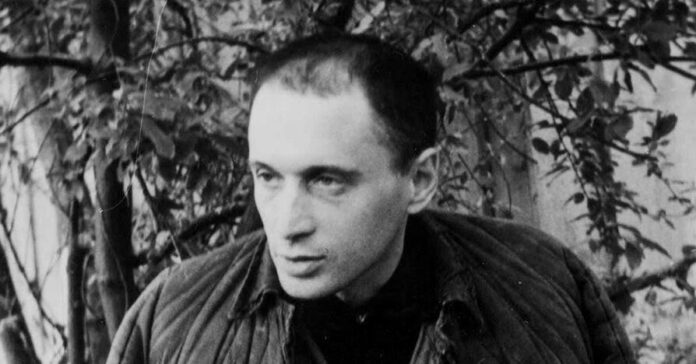

On May 11, 1972, Soviet police arrived at the Kyiv apartment of a young psychiatrist named Semyon Gluzman.
Officially, he was charged with spreading “anti-Soviet agitation and propaganda.” But his real crime, the one officials did not want publicized, was questioning the Soviet Union’s widespread use of psychiatry as a tool of oppression — and being the first doctor to do so.
A year earlier, the dissident physicist Andrei Sakharov had asked Dr. Gluzman to evaluate Gen. Petro G. Grigorenko, who had been declared insane after he protested the Soviet Union’s deportation of Tatars to Central Asia from Crimea.
Like thousands of others who spoke out against the government, General Grigorenko (who was of Ukrainian descent and whose surname could also be transliterated as Hryhorenko) was diagnosed with “sluggish schizophrenia,” a condition invented by psychiatrists in Moscow in the 1950s. It was bunk science, but politically useful: The disorder was said to be slow-acting and undetectable by the layperson, manifesting in antisocial outbursts like criticizing the Communist regime.
General Grigorenko was confined to a mental hospital, so Dr. Gluzman had to rely on interviews with colleagues, military evaluations and a leaked copy of the official diagnosis in making his assessment.
He declared General Grigorenko sane, a judgment that was confirmed years later when the general was allowed to immigrate to the United States.
But Dr. Gluzman’s report, which Dr. Sakharov distributed through underground channels, was more than a statement about one man’s mental health. It was a concise, concrete indictment of the Soviet psychiatric system — and, by extension, of the Soviet Union itself.
“Psychiatry is a branch of medicine and not of penal law,” he wrote, a seemingly reasonable stance that earned him seven years of hard labor and three years of exile in Siberia.
Dr. Gluzman, known to friends as Slava, died on Feb. 16 at a hospital in Kyiv, Ukraine’s capital. He was 79.
His daughter, Julia Piivskaya, confirmed the death, which was not widely reported at the time.
Dr. Gluzman’s sentence, which he served at the notorious Perm 35 penal camp in the Ural Mountains, made him a cause célèbre in the world of international human rights. Dr. Sakharov pleaded his case with Western governments and medical associations.
In prison, Dr. Gluzman and another inmate, the writer Vladimir Bukovsky, collaborated on “A Manual on Psychiatry for Dissidents,” writing the manuscript on sheets of paper that were smuggled out in the lining of canvas bags they made in the camp’s factory.
The 22-page manual advised dissidents on how to avoid being declared mentally ill during an interrogation by a Soviet psychiatrist. Among other tips, it advised arguing your opinions “not by personal experience or analysis of reality but with reference to literary sources, assertions of authorities and so forth.”
The manuscript was quickly translated into English, German and other languages, and it received widespread attention in the international news media.
Dr. Gluzman refused offers of leniency in exchange for disavowing his report on General Grigorenko, and he repeatedly criticized the camp administration for its poor treatment of prisoners — criticism that earned him stretches in solitary confinement.
“If Slava felt that the king was naked, he had no problem saying it and saying it again and saying it again,” Robert van Voren, a friend and close associate, said in an interview. “Nothing could change his mind.”
Semyon Fischelovich Gluzman was born on Sept. 10, 1946, in Kyiv. His parents, Frischel Gluzman and Galina Mostovaya, were doctors.
After graduating from the Kyiv Medical Institute (now the National Medical University) in 1970, he worked in various hospitals around Ukraine. Even before his assessment of General Grigorenko, he was under suspicion for refusing to work at certain hospitals that he knew were used to hold political prisoners.
He married Irina Piivskaya in 1974. Along with their daughter, she survives him.
Dr. Gluzman returned to Kyiv from Siberia in 1982, but he was barred from practicing medicine. Instead, he spent two years working as a locksmith at a factory. Eventually authorities allowed him to resume practicing medicine, but only as a pediatrician.
After the fall of Communism and the breakup of the Soviet Union, Dr. Gluzman became a leading figure in the effort to modernize and reform the psychiatric profession.
In 1991, he established the Ukrainian Psychiatric Association and pointedly announced that it was open to anyone, including former Soviet doctors, as long as they adhered to its commitment to human rights, science and independence.
At the same time, he led efforts to confront the abuse of psychiatry during the Communist era, as director of the International Medical Rehabilitation Center for the Victims of War and Totalitarian Regimes.
He also began publishing Western psychiatry textbooks and journals in Ukrainian, an important step for a field that had been almost completely cut off from the rest of the world for decades. (He published significant general-interest books as well, including a Ukrainian edition of “The Diary of a Young Girl” by Anne Frank.)
In 2008, the World Psychiatric Association awarded Dr. Gluzman the Geneva Prize for Human Rights in Psychiatry, one of many honors he received in recent decades.
He continued to live humbly, in a small apartment on the 15th floor of a Soviet-era tower in suburban Kyiv.
In 2022, invading Russian soldiers came within about five miles of the building. His friends, including Mr. van Voren, tried to persuade Dr. Gluzman to flee. He refused.
“I called him, and he picked up,” Mr. van Voren recalled. “I hadn’t even opened my mouth when he said: ‘I know why you’re calling. If you ask me once that I need to leave this flat, I will never pick up again. This is my freedom. This is my home.’”