
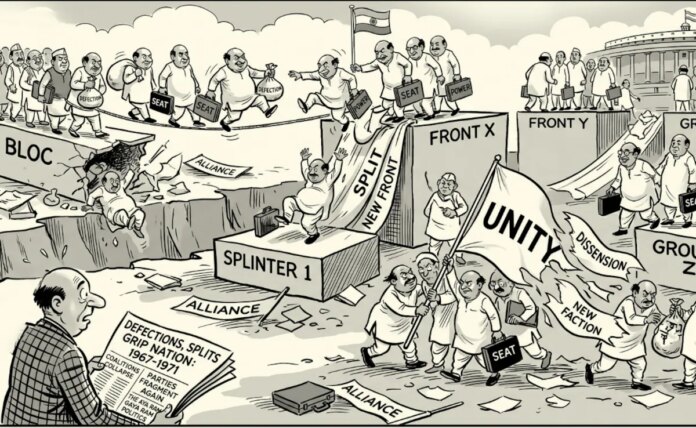

Raghav Chadha rebelled. The Aam Aadmi Party was jolted. The BJP made a massive gain.
But the exodus from the AAP has once again shone a spotlight on elected representatives switching parties, a trend that became so intense for four years that voters began questioning the future of democracy in India and an anti-defection law was brought in.
That period, between 1967 and 1971, is referred to as the “Era of Instability,” during which 45 governments were formed, and collapsed, across various states. It marked the end of the Congress’ post-Independence domination and the beginning of the experiment with coalition governments.
Advertisement – Scroll to continue
During this phase, President’s Rule – invoking Article 356 of the Constitution – was imposed 16 times. More than 1,800 legislators defected, and approximately 115 of them were rewarded with ministerial portfolios. It was also during this period that the saying “Aaya Ram, Gaya Ram” gained currency in Indian politics.
A Landmark Year
During the 1967 polls – the last time simultaneous elections were held for the Lok Sabha and state assemblies – the Congress failed to secure a majority in eight states, including Uttar Pradesh, Bihar, West Bengal, Odisha, Madras (now Tamil Nadu), Kerala, Rajasthan, and Punjab.
While the DMK secured a majority in Madras, governments of the Samyukta Vidhayak Dal, a coalition of non-Congress parties, were formed in the other states. Ideologically disparate, these coalitions were rife with internal contradictions, bringing together entities as divergent as the right-leaning Bharatiya Jana Sangh and communist parties.
With virtually no ideological alignment, these incongruous coalitions created a fertile ground for political defections. Several influential Congress leaders, driven by the ambition to become chief minister, went so far as to split their own party.
The Congress, then ruling at the Centre, also played a role by destabilising opposition coalition governments through the use of governors. On several occasions, it imposed President’s Rule under Article 356 without even granting the incumbent governments an opportunity to prove their majority on the floor of the House.
Political Instability
Massive political defections took place across north India. Haryana, Uttar Pradesh, Madhya Pradesh, Bihar, and Punjab alone witnessed the formation and collapse of over 30 governments. A similar, albeit less extreme, pattern was seen in east and south India as well.
This wave of political defections was so widespread and alarming that, in 1968, a committee was constituted under then Home Minister YB Chavan to address the issue. Within a year of the 1967 elections, this committee recorded hundreds of instances of defection, which remains the earliest and most authoritative official document on the political malaise.
The events are also chronicled in a systematic manner in the book ‘The Politics of Defection: A Study of State Politics in India’, authored by the renowned constitutional expert and former Lok Sabha secretary general Subhash C Kashyap. He describes how, in the post-1967 period, governments crumbled like houses of cards due to the “horse-trading” of legislators.
Ground Zero
Haryana emerged as the epicentre of this politics of defection. In 1967, a Congress government was formed but, within a short time, MLA Rao Birender Singh split the party and took several legislators with him. He then founded the ‘Vishal Haryana Party’ and took over as the chief minister. During the same period, Gaya Lal, the MLA from Hassanpur in Haryana, switched parties three times within a fortnight, giving rise to the saying ‘Aaya Ram, Gaya Ram’, which became synonymous with political turncoats. Ultimately, due to this persistent instability, President’s Rule had to be imposed in the state in November 1967.
In Uttar Pradesh, Congress leader Chandra Bhanu Gupta formed a government, but it survived for a mere 18 days. His colleague Chaudhary Charan Singh rebelled along with 17 legislators and formed the ‘Bharatiya Kranti Dal’. In alliance with the Jana Sangh and the socialists, he formed a ‘Samyukta Vidhayak Dal’ (SVD) government. However, due to ideological differences with his coalition partners, this government, too, collapsed in February 1968, and President’s Rule was imposed in the state.
In Madhya Pradesh, the wave of political defections was spearheaded by Rajmata Vijayaraje Scindia of Gwalior. She launched a frontal attack against Congress Chief Minister Dwarka Prasad Mishra. Govind Narain Singh switched sides along with 36 Congress legislators and formed an SVD government. Plagued by factional politics and then suffering defections itself, this regime, too, survived only until 1969.
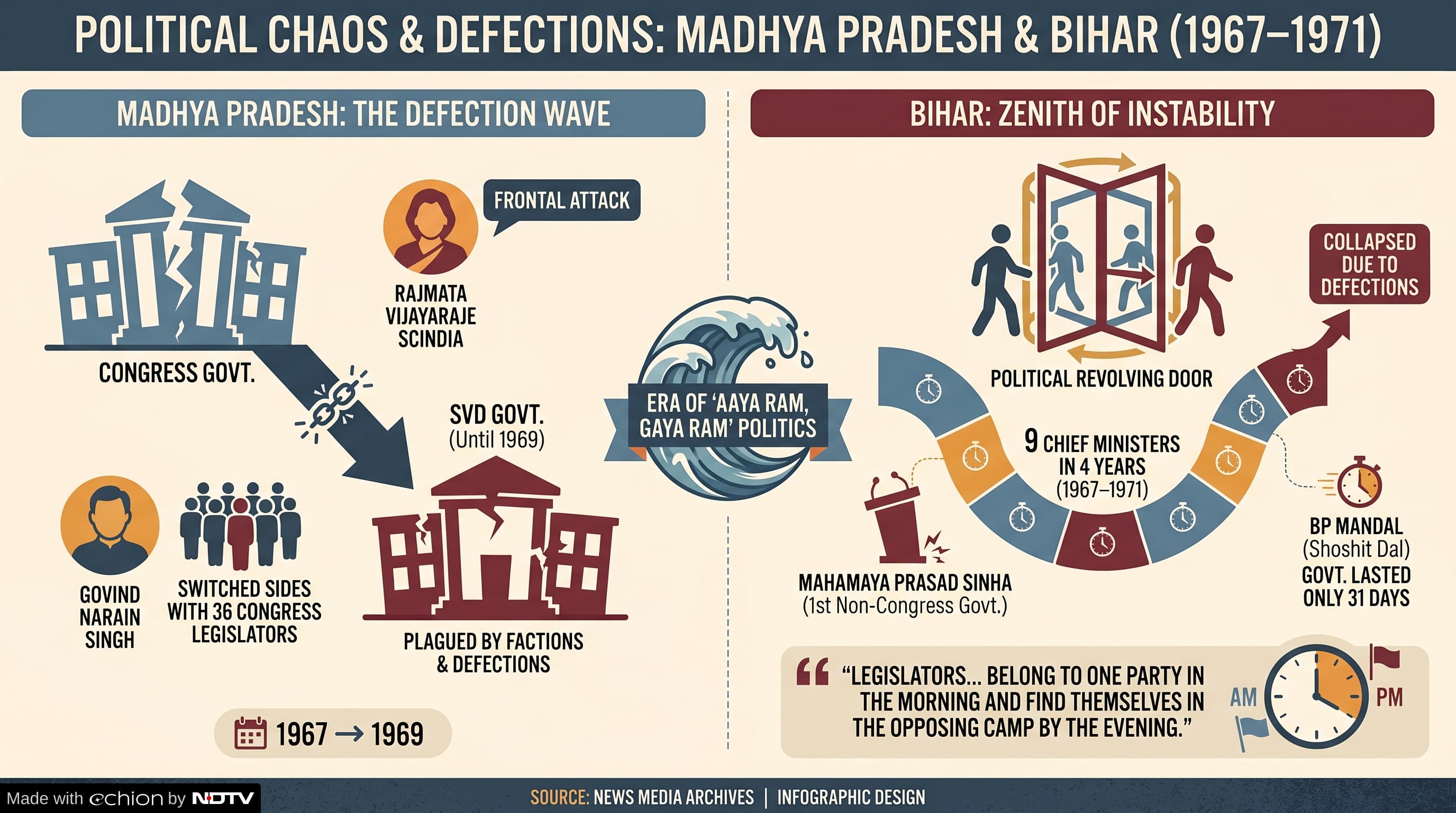
Bihar, meanwhile, was reaching the zenith of political instability, witnessing nine chief ministers between 1967 and 1971. Mahamaya Prasad Sinha’s first non-Congress government collapsed due to political defections. BP Mandal formed the ‘Shoshit Dal’ and took over as chief minister with external support from the Congress, but his government lasted only 31 days. The situation became so farcical that legislators would belong to one party in the morning and find themselves in the opposing camp by the evening.
In West Bengal, under the leadership of Ajoy Mukherjee, the ‘Bangla Congress’ and Left parties joined forces to form a ‘United Front’ government. However, Congress strategists instigated PC Ghosh to defect, leading to the collapse of the government. Ghosh became the chief minister, but his government remained unstable as well. In Bengal, alongside political defections, political violence also inflicted severe damage upon the democratic process.
The Akali Dal (Sant Fateh Singh faction), in alliance with other parties, formed the ‘Popular United Front’ government in Punjab. However, Lachhman Singh Gill defected along with 16 legislators and formed a government with the external support of the Congress. His government collapsed within nine months and the state saw frequent spells of President’s Rule and mid-term elections during the period.
Ministerial Lure
There were a few key factors that led to, or contributed to, the fall of the 45 governments. One in every eight defecting legislators was rewarded with a ministerial berth, and the lure of the ‘red beacon’ (a symbol of ministerial status) began to outweigh political loyalty.
The Congress also faced accusations of using the office of the Governor to destabilise opposition-led governments. This was made easier by the fact that the Samyukta Vidhayak Dal (SVD) governments possessed no shared agenda other than their opposition to the Congress – a lack of cohesion that ultimately caused them to crumble under internal pressures.

This political instability and mass defections played a huge role in the electorate handing Indira Gandhi a massive majority in 1971, rallying behind the slogans of a ‘strong Centre’ and a ‘stable government’. Gandhi’s faction of the Congress, called the Indian National Congress (Requisitionists), won 352 of 521 seats in the Lok Sabha, ensuring a temporary halt to the wave of political defections.
The Chavan Committee, meanwhile, put forth several significant recommendations. It was recommended that the size of the Council of Ministers should not exceed 10-11% of the total strength of the legislative assembly. Later, in 2003, this limit was fixed at 15% through the 91st Constitutional Amendment.
The committee further stipulated that if legislators quit their party, they should be barred from being appointed as a minister or chief minister for a minimum period of one year. The panel characterised political defection as a betrayal of the electorate’s trust and recommended that political parties refrain from fielding defectors as candidates in elections.
It was on the basis of this report that, in 1985, the then Rajiv Gandhi government enacted the Anti-Defection Law, introducing it as the 10th Schedule of the Constitution through the 52nd Constitutional Amendment in 1985. Significant amendments were made to the schedule to strengthen it in 2003 during the tenure of the Atal Bihari Vajpayee government.
Friday’s AAP exodus will not trigger the law because seven of 10 Rajya Sabha MPs of the party, including Raghav Chadha, are merging with the BJP, which meets the critical two-thirds threshold.
The 10th schedule allows a party to merge with or into another party provided that at least two-thirds of its legislators are in favour of the merger.