

New Delhi:
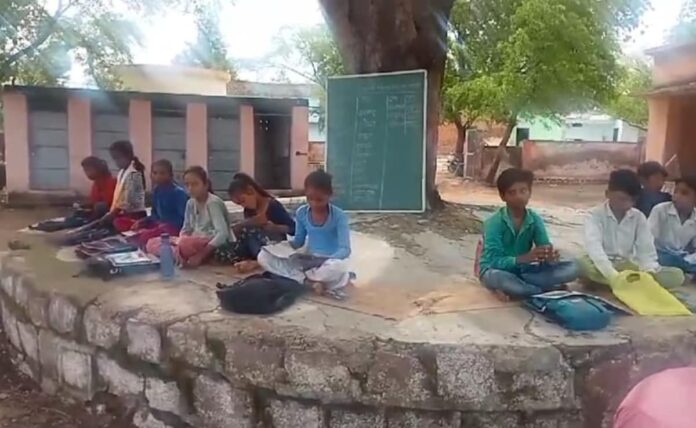
Thousands of schools in the country are functioning without water supply, without toilets, without electricity, without labs, without teachers, and some don’t even have students. Further, high drop-out rate from schools after primary classes remains a big problem in several states. If all this was not enough, only 10-15 per cent of the teachers in government schools can score above 60 per cent in the subject they teach.
The findings of Niti Aayog’s new report, titled “School Education System In India”, reveals that thousands of schools still lack basic facilities like toilets and handwash. The report, released on Thursday, compiles national and state-level data on school infrastructure, staffing, enrolment and learning indicators.
Niti Aayog’s School Education Report: Basic Infrastructure
While the report notes high overall toilet coverage percentages, it points out that 98,592 schools in the country do not have functional girls’ toilets while 61,540 don’t have any usable toilet.
Similarly, the report maintains that electricity access for schools has improved from 55 per cent to 91.9 per cent over the past decade. However, 1.19 lakh schools are still without functional electricity.
Further, 98,592 schools in the country still don’t have functional girls’ toilets, with 61,540 not having any usable toilet. Also, about 14,505 schools lack water access. Meanwhile, 59,829 schools don’t have handwash facilities.
The report goes on to add that only 51.7 per cent of government secondary schools have science laboratories.
Niti Aayog’s School Education Report: Teacher Vacancies
There are 1,04,125 schools in the country running with a single teacher, as per the report. About 89 per cent of these schools are located in rural areas. In addition, some states show high pupil-teacher ration (PTR) at the secondary level. In Jharkhand, government secondary schools have a PTR of 47:1 — an ideal student-teacher ratio is considered to be between 10:1 and 18:1.
Highest elementary teacher vacancy figures have been recorded in these states:
- Bihar: 2,08,784
- Jharkhand: 80,341
- Madhya Pradesh: 47,122
Competency of teachers is another factor hindering qualty education in India. The report reveals that 2 per cent teachers can score above 70 per cent in Mathematics, with the average score remaining 46 per cent. Additionally, 14 per cent of teaching days (on average) are lost to non-academic duties such as surveys, elections, and administrative work.
Niti Aayog’s School Education Report: High Drop-Out Percentage
Coming to enrolment, there are around 7,993 schools in the country with zero enrolment. West Bengal has the highest share of such “ghost” schools (3,812), folllowed by Telangana (2,245).
Another big challenge is the high drop-out rate from secondary schools. The national average for secondary dropout rate is 11.5 per cent. States with higher (than national average) drop-out rates:
- West Bengal: 20%
- Arunachal Pradesh: 18.3%
- Karnataka: 18.3%
- Assam: 17.5%
In fact, the situation in Uttar Pradesh and Bihar has deteriorated with more children dropping out from secondary education. In Bihar, the secondary drop-out percentage has gone up from 2.98 per cent to 9.3 per cent. Similarly, in Uttar Pradesh, this number has gone up from 0.52 per cent to 3.0 per cent.
Niti Aayog’s School Education Report: Overall Indicators
The report also points out that India just spends 4.6 per cent of its GDP on education. This figure is about 5.9 per cent for the UK and the US, and about 5.4 per cent for Germany and France.

As per Parakh-based outcome mapping, Jharkhand, Gujarat, and Jammu-Kashmir have performed poorly. On the other hand, Punjab, Himachal Pradesh, Odisha, Maharashtra, and Rajasthan have performed better.
Parakh (or Performance Assessment, Review, And Analysis of Knowledge for Holistic Development) is the national assessment regulator created in 2023 under the National Council of Education Research and Training (NCERT), as mandated by the National Education Policy 2020.