

Fourteen communities and First Nations have declared flood-related states of local emergency in Saskatchewan within the past 48 hours, according to the provincial safety agency’s update on Thursday.
These were in response to this year’s spring thaw, which has been heavier than usual, the Saskatchewan Public Safety Agency (SPSA) said, with up to 35 communities in active states of emergencies.
The SPSA said it has a presence in all these communities.
On flood conditions, the Water Security Agency (WSA) forecasted the weather warming in the east central and northeast. Those pockets were said to be the hardest hit, as of late, with some communities near Carrot River evacuating.
Record flows were reported from that river, Leah Clark with the WSA said.
Despite the upper river having peaked already, the lower basin is starting to recede, but flows remain high, she added.
Saskatchewan’s share of the Red Deer River basin is yet to peak, and Clark said she expects it will in the coming days.

Get breaking National news
Get breaking Canada news delivered to your inbox as it happens so you won’t miss a trending story.
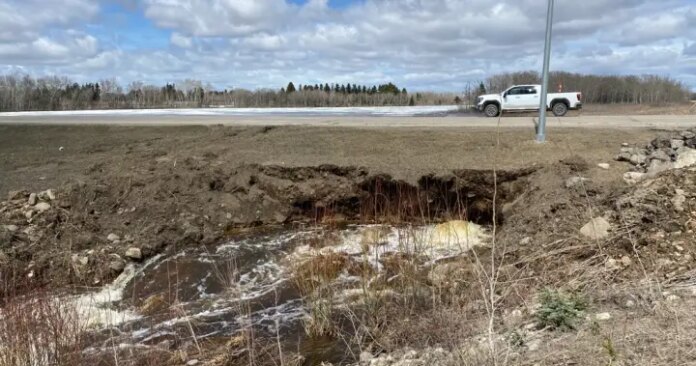
Flooding has also shut down some of Saskatchewan’s highways, as overland waters hit the roads. The Highway Hotline has 11 flood-related closures on provincial highways.
The SPSA could not say how many homes have been damaged.
“In widespread flooding, we are not aware of where those impacts are unless the RMs have sought assistance,” said Steve Roberts, the vice-president of operations at the SPSA.
It is hard to track exactly how many houses are impacted as most homeowners go through insurance, and most floods are municipally managed, he added.
Infrastructure in some Saskatchewan communities was damaged from flooding and highways leading into some flood-ridden regions were cut. The roads were sliced to alter the flow’s path, pushing it away from localities.
Work on temporary fixes using gravel and other road fillers will commence once the areas dry.
“As far as costs go or anything like that, I mean it’s way too early to tell,” Kim Gartner, the minister of highways, told reporters on Thursday.
When floodwaters recede, work on damage reports will begin, the MLA for Kindersley-Biggar said.
“We’ll do an evaluation and assessment of every location that we have,” said Gartner. “We look after 700 bridges and over 26,000 kilometres of highways, so we have professionals that do that for us.”
Long-term repairs will enter the planning phase when the documents are delivered, the highway minister said.
Gartner said he was headed to tours in some impacted communities after the legislature’s question period in Regina.
© 2026 Global News, a division of Corus Entertainment Inc.