
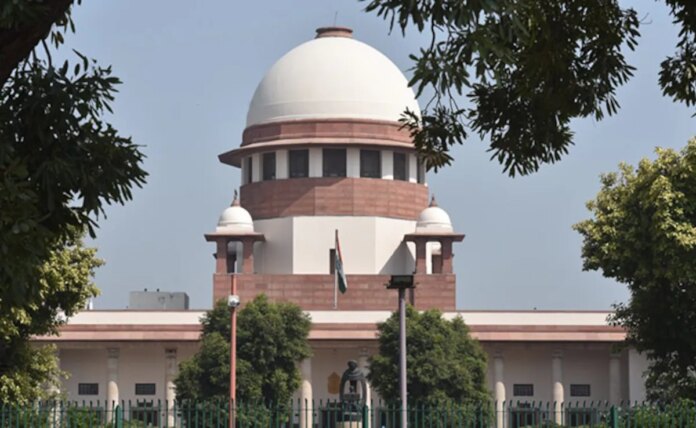

The Supreme Court on Thursday expressed its concern about the practice of female genital mutilation among sections of the Dawoodi Bohra community and said it may hit on the ground of “health” under the Constitution.
Under Article 25, religious practice can be restricted on the ground of health, apart from public order and morality.
A nine-judge constitution bench headed by Chief Justice Surya Kant, which was hearing petitions challenging this practice, was told by senior advocate Siddharth Luthra that it has been banned in around 59 countries across the world and in some, including Egypt and Australia, the courts have intervened.
“There is no specific prohibition in India,” he said, adding that the important question here is that the community or denomination impairs the life of a minor in the absence of consent because for the minor there cannot be a meaningful consent.
Lutha, appearing for the petitioners opposing female genital mutilation, told the bench that the practice is done on young girls aged 7 years, and it causes an irreversible change in their bodies, which will affect their sexual and reproductive health as several thousand nerves are damaged in the process.
He told the bench also comprising justices BV Nagarathna, MM Sundresh, Ahsanuddin Amanullah, Aravind Kumar, AG Masih, PB Varale, R Mahadevan and Joymalya Bagchi that many families follow the practice because of the fear of excommunication if they do not adhere to it and this practice cannot be claimed as an essential religious practice, and cannot be covered by the rights of a denomination under Article 26.
Justice Bagchi said, “As far as female genital mutilation is concerned, we may not even need to travel into all these issues and other rights. The expressions ‘health’ and ‘public health’ themselves may be sufficient to hit it.” Luthra said where a practice intrudes into bodily autonomy and mutilates a vital organ, it necessarily falls foul of the limitations under Articles 25 and 26, namely public order, health and morality.
Justice Nagarathna observed that the practice would also be hit by the ground of “morality” under Article 25.
Justice Bagchi said the religious practice would require a closer scrutiny as it has not only the secular consequence of excommunication for not following the practice, but also the effect on the “bodily, mental integrity and sexual autonomy” of the individual.
Justice Varale added that the impact of the practice is “multi-fold”.
Justice Bagchi, adding to the view, said that it was to control women’s sexuality.
Luthra submitted that the bench should also consider the power structures operating and the social compulsions faced by the individuals within the community.
CJI Kant asked Luthra whether he was suggesting that, regardless of the interplay between Articles 25 and 26, if a religious practice is interfering with the other fundamental rights of an individual, then the court should intervene.
Replying in affirmative, Luthra said the subjects of this practice are minors, who are incapable of giving consent.
Advocate Nizam Pasha, also appearing for some intervenors said there is no excommunication for not following female genital mutilation.
Disputing the description of the practice as “mutilation”, Pasha added that within the community, there are no worldly consequences for not following this practice, though the members may believe that there could be spiritual consequences.
Justice Bagchi posed a specific question if there is any consequence for breaching the direction of the Dai (Bohra community religious head).
Pasha said there are no worldly consequences and if one does not offer namaz, there is no punishment imposed, however mandatory namaz may be desired.
“Similarly, there is no excommunication attached to non-observance of this practice. There is no worldly sanction in the Dawoodi Bohra faith for non-adherence to this practice. No excommunication, no religious sanction,” Pasha replied.
He drew a similarity with the practice of circumcision among men in Islam.
Justice Bagchi then said, “From a public health perspective, there is a difference between circumcision and genital mutilation.” Pasha claimed that it was not mutilation, but was a practice similar to “hoodectomy” practised in the West.
“The description is disputed. It is not mutilation. It is described within the community as a symbolic circumcision. The procedure referred to is known in the West as hoodectomy, involving the clitoris,” he added.
Justice Nagarathna asked Pasha what the objective of this practice was.
“To increase the sexual pleasure of women,” Pasha replied.
Justice Amanullah immediately interjected him and said, “It is just the opposite.” Justice Amanullah also took objection to Pasha drawing parallels with circumcision.
“Also, I’m surprised it is compared to circumcision; it is a different concept. Get your facts correct,” Justice Amanullah told Pasha.
Justice Amanullah said regardless of excommunication, since the religious practice is regarded as mandatory, the court will have to test it.
The hearing remained inconclusive and would continue on May 12.
(Except for the headline, this story has not been edited by NDTV staff and is published from a syndicated feed.)