
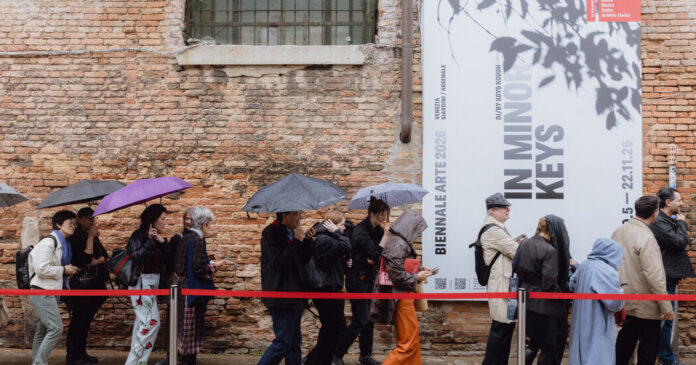

The Venice Biennale is the world’s most prestigious international art exhibition. But in the lead-up to this year’s event, the art part of it has been somewhat overshadowed by, well, everything else.
First, the curator died unexpectedly. Then Russia returned to the exhibition for the first time since 2022. Then the Biennale’s jury said it wouldn’t award prizes to artists from countries whose leaders are being investigated for war crimes, which many people read as code for Israel. Then, when an Israeli artist threatened to sue, the jury resigned altogether.
I spoke to my colleague Alex Marshall, one of our culture writers, about what it has felt like to be in Venice for the Biennale in the midst of all of this. We also spoke about some of the (pretty wild!) art.
Politics, scandal, tragedy and art at the Biennale
So, Alex, this year’s Biennale has become about more than just art. Let’s start with the geopolitical tensions. Can you feel them as a visitor?
Oh, you can’t escape them. All the pavilions are basically on two small sites. So Russia’s pavilion is 50 meters away from the Ukrainian installation. All the pro-Palestinian artists are walking past the Israeli pavilion all the time.
Walking around this week, I came across anti-Russian protests, I came across anti-Israel protests. There’s also lots of security outside the American pavilion, which people here see as the Trump pavilion.
The Biennale is always overwhelming for art. But this time I don’t just feel overwhelmed by art, I also feel overwhelmed by the politics.
Tell me about the curator who died.
Koyo Kouoh was one of the world’s most respected museum directors and art curators, and certainly the most prominent African woman on the world art stage. And so her curating this major show felt like a huge moment. It was a big shock when she died of cancer last year.
Her team insists they basically realized her vision for the exhibition: She had plans in place; she had chosen the artists she wanted. And you go in the show and she is everywhere, in part because some of the artists have made tributes to her. There’s this one big portrait of her and Toni Morrison, and it’s one of the first things you see. So, is this still her exhibition? Yes. But I imagine if she was alive, it might have still been different.
How so?
Kouoh’s theme for the Biennale — “In Minor Keys” — was, according to her, an attempt to “shift to a slower gear” and reconnect with shared humanity, far away from “a litany of commentary on world events.”
Which is ironic given how things have turned out.
Yeah, although some artworks really do take you away from the noise. There’s one piece that stood out to me. This guy Theo Eshetu, a British-Ethiopian artist, sent a tree and it rotates to the sound of a music box. It’s very beautiful and a real moment of stillness in this exhibition.
How is any of this art going to be judged now that the jury has resigned? Has that ever happened before?
Not to my knowledge. And you have to understand: The climax of the opening week of the Biennale is the jury awarding prizes to the best artist of the main show and the best pavilion.
So now you have a situation where the public are going to pick the winners by casting votes, which a lot of the artists are annoyed about, because they think the public’s taste is going to favor the popular stuff. But also, the process could easily be manipulated by, say, a country deciding to launch some sort of campaign to get people to vote for its pavilion.
Let’s talk about the art. What’s the buzziest pavilion this year?
Austria, by a million miles.
It’s by a choreographer and theater-maker named Florentina Holzinger. She’s staging a show called “Seaworld Venice” in which she’s flooded the Austrian pavilion. There’s a naked woman doing doughnuts on a jet ski in one of the rooms. There’s a tank where another naked woman is submerged in water, there are portable toilets nearby, and when you pee in them, your pee gets sent through a filtration system and enters the tank where this woman is floating. There’s another room where fake sewage is flying out of pipes.
It’s all kind of mad, but it does have a message. Venice is a city at risk of going underwater. We are wasting resources, often on absurd things, like that woman on a jet ski, going around in circles. People here are discussing those messages.
That’s wild. And is there a lesser known artist that you want to highlight?
It’s so hard to choose. Overall it’s just such an amazing experience.
Like, last night I popped out to get some milk and decided to drop by the Kosovo pavilion, because it happened to be next to the supermarket. And I saw this striking painting by an artist called Brilant Milazimi, a vast painting of people waiting in a queue in this horrific, apocalyptic landscape.
You could see it as a comment on refugees. You could see it as a comment on the awfulness of human existence. Or you could just see it as a cool blood-red painting. And I thought, you know, what a privilege to see something like that at 6 p.m. on a weekday evening when you’re just going out to buy some milk.
For more: See photos of the art, the protests and the parties.
Iran says it is considering a peace plan
Iranian officials said their country is discussing with the United States a one-page proposal to reopen the Strait of Hormuz and end hostilities for 30 days while both sides try to reach a comprehensive deal.
The plan would lift the U.S. blockade on Iranian ships and ports, and open the strait to commercial traffic, according to three senior Iranian officials. They said the key remaining obstacle was the U.S. demand for advance commitments on the fate of Iran’s nuclear program and its stockpile of highly enriched uranium. Follow our live updates.
Explosions in Iran: State media reported multiple explosions at Iranian shipping hubs on the Strait of Hormuz. Iranian officials said the United Arab Emirates had carried out the attacks in retaliation for Iranian drone and missile strikes this week.
SUNKEN TREASURE OF THE DAY
About 5,500 objects that went down with the Titanic more than a century ago have been recovered since the ship was found in 1985 at the bottom of the North Atlantic. About 100 of them may soon be put up for auction. They could include a bronze cherub statue from the ship’s Grand Staircase, a bell from the crow’s nest, a safe and a pendant necklace.
MORNING READ
China’s biggest factory investment in Europe is a gigantic lithium battery plant that has been under construction in Hungary for three years. For Hungary’s departing prime minister, Viktor Orban, the plant was proof that close ties to China bring economic benefits.
But Peter Magyar, who will be sworn in tomorrow as the new prime minister, has promised to review the project to consider possible environmental hazards. The factory’s fate is shaping up as an early test for the new leader. Read more.
AROUND THE WORLD
Not your average sake
Terada Honke is one of Japan’s last natural sake breweries. The 350-year-old family business holds fast to tradition, using manual techniques and wild yeast. It grows a portion of its own rice locally and is the only brewery in Japan to cultivate its own koji, the mold used to ferment the grains for brewing.
The ancient methods have allowed the company to stand out and survive in a struggling industry. Consumption of sake, once the heart of Japan’s drinking culture, has declined by 75 percent since the 1970s. Watch how the sake is made.
RECIPE
Mother’s Day will be celebrated on Sunday in many countries, and if you want to skip the flowers this year, consider making her this legendary banana pudding from Magnolia Bakery in New York. It’s airy, creamy and easy to assemble.
Where are they biking?
BEFORE YOU GO …
One of my earliest childhood memories is of my dad taking me with him to vote. It was the West German federal election of 1983. I still remember the voting booth — a small compartment behind a thick black curtain — and the wooden box in which I was allowed to drop my dad’s ballot.
That day left a big impression. My dad explained the privilege and duty of voting, over the biggest ice cream you can imagine. (He wanted a captive audience!) To this day, I associate voting with a banana split.
Yesterday, I took my 10-year-old son with me to vote in parliamentary elections in Wales. He was allowed to drop my ballot into the ballot box. Then I bought him some ice cream and told him about the privilege and duty of voting.
It’s something I’ve done with all my children. So far, they’ve all been a little “Whatever, mum, thanks for the ice cream” about it. But I’d like to think that one day they’ll remember (and not just because of the ice cream).
And while we wait for the election results, I have an awesome song-and-dance combo for you. Check out the Dutch hip-hop trio Let it Happen strutting their stuff to the music of the great James Brown. (And if you’re as obsessed as I am, scroll on. They’re electric.)
Have a great weekend! — Katrin
TIME TO PLAY
Here are today’s Spelling Bee, Mini Crossword, Wordle and Sudoku. Find all our games here.
We welcome your feedback. Send us your suggestions at theworld@nytimes.com.