
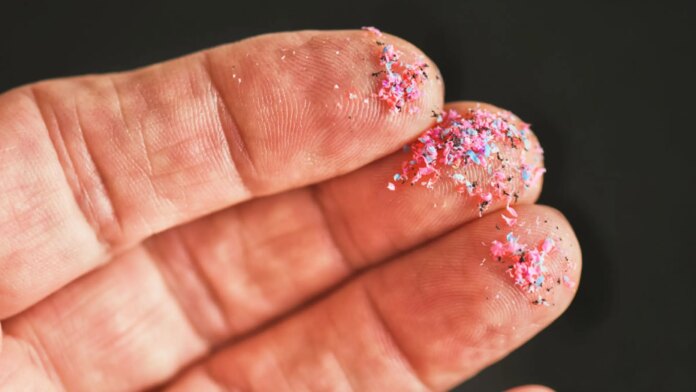

Microplastics seem to be everywhere—from our oceans and air, to drinking water and cosmetic products. Researchers have even found evidence of microplastics, and smaller nanoplastics, throughout the human body.
Now, scientists have reason to believe that airborne microscopic particles could even be contributing to the warming of our planet. It begs the question: how worried should we be?
What are the sources of airborne microplastics?
Microplastics are minuscule particles— less than five millimeters in size—that originate from the disintegration of plastic products. As plastics break down, whether that be through washing polyester clothing or wearing out our tires, microscopic particles of plastic shed, small enough to be picked up and transported by the air.
Once in the air, they can impact the atmosphere in different ways. “Particles in the air can affect the air in two ways,” says Fay Couceiro, professor of environmental pollution at the University of Portsmouth. “They either reflect the sunlight back out to space so it doesn’t heat so it cools the surface, so it doesn’t heat the planet, or they absorb it, and then they warm the air around them, and it does warm the planet.”
What is the climate impact of microplastics?
A study published in Nature Climate Change earlier this week found that, on the whole, airborne microplastics—particularly black and colored particles—seem to be absorbing more heat than they are reflecting, contributing to global warming. The researchers estimate that microplastics in the atmosphere could be contributing to global warming at about one-sixth the amount of black carbon, or soot, a pollutant generated from the burning of fossil fuels.
One thing is clear: the scale is nowhere near greenhouse gases like carbon dioxide or methane. “They are, in reality, a very, very tiny fraction of the contaminants that we have within our air,” says Ian Mudway, associate professor of environmental toxicology at Imperial College London’s School of Public Health, who was not involved in the Nature study.
However, that doesn’t mean the issue should be ignored entirely.
“Do I think we should be concerned? Yes. Do I think we should be in panic mode? No,” says Couceiro, who wasn’t part of the new study. “We don’t have enough evidence to suggest we need to get rid of everything that’s plastic on the whole planet. But… I think we should be concerned, and we should be looking to limit our exposure and prevent the exposure from getting any worse.”
How harmful are microplastics to the human body?
There’s a lot we don’t know about how microplastics impact human health. “It takes a long time to tease out what’s the impact from plastic, as opposed to the impact of obesity or the impact of age or the impact of all sorts of other things that we have in our lives,” says Couceiro.
What we do know isn’t promising. Human cell culture studies have revealed that high concentrations of microplastics in cells can cause anything from inflammation to endocrine disruption. One study Couceiro worked on examined the impact of microplastics on algae, and found the presence of microplastics led to major ecosystem disruptions. “There’s reduced growth [of the algae], and that has a knock on effect for all of the animals that need to feed on it,” she says. “So you have impacts on their food source, but you also have impacts on them directly. If the animal ingests it, for example, it can block their gut, it can get in their gills and make it harder for them to breathe, or the chemicals in them leaching out that cause problems with their hormones and infertility.”
Just because we don’t fully understand the impact on human health doesn’t mean we should postpone action until we do, says Mudway, “The fact that it’s devastating for our environment should be enough for us to act, and yet we’re always desperately trying to demonstrate that it must be bad for human health, because that would be the motivator which would allow us to tackle this problem.”
How do you get rid of airborne microplastics?
Completely eliminating microplastics from the atmosphere is currently impossible. “Even if we stop producing [plastics] there will still be more buildup in the environment for some time,” says Couceiro.
If you’re concerned about exposure, there are steps you can take in your home. One study found that high-efficiency HEPA filters, designed for air purification, can successfully remove over 99% of nanoparticles indoors.
Couceiro recommends considering ways you can reduce the amount of plastic in your life. “Reducing the amount of plastic that we have in our homes will reduce the amount [of microplastic] we breathe in,” she says. “We need to approach it sensibly, but there’s enough evidence of harm that we should be concerned.”