
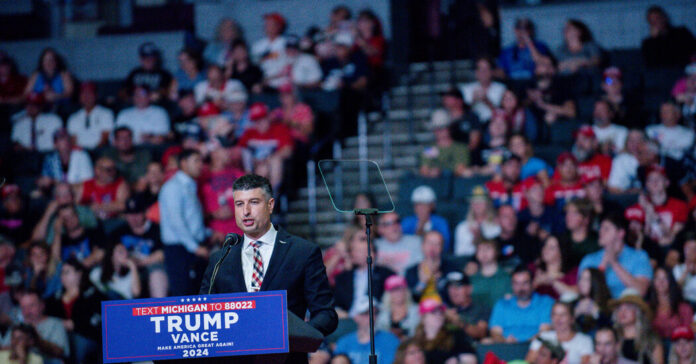

A first-term House Republican facing a difficult re-election fight introduced a bill on Thursday that would authorize continued U.S. military operations in Iran through the end of July, but with strict limits, implicitly rejecting President Trump’s claim that the war has ended.
The legislation by Representative Tom Barrett, a Michigan Republican, was the latest indication of growing uneasiness among Republicans on Capitol Hill about the war, which Mr. Trump began with no authorization from Congress and which has dragged on far beyond his initial timetable. Unhappiness with the war has further darkened an already grim political environment for the G.O.P. as it grasps to keep its majorities.
Mr. Barrett, an Army veteran whose race to hold onto his Lansing-area district is considered among the most competitive in the country, said the legislation was an effort to give Congress a say in the ongoing conflict.
The bill would largely bar the introduction of ground forces and would specify how force could be used in Iran. Those uses would include to “demolish, degrade, or defeat” Iran’s nuclear program, to address “imminent threats” to American forces or facilities, to enforce a blockade of Iranian ports, and to ensure the safe passage of U.S. and allied ships through the Strait of Hormuz.
“The commander in chief has the sole authority to lead our troops in wartime, but I’ve lost too many friends on the battlefield to allow that to happen without Congress exercising its constitutional role to clearly define the mission with safeguards and a deadline,” Mr. Barrett said in a statement announcing the measure, which he filed during a congressional recess.
The move comes days after Mr. Trump told Congress that the 60-day statutory deadline for him to withdraw forces or obtain authorization to keep them in Iran, which fell on May 1, did not apply to him because active hostilities had ended with the start of an April 7 cease-fire.
Despite the president’s assertion that “no exchange of fire” had taken place since then, U.S. naval forces have enforced a blockade of Iranian ports and tens of thousands of troops have remained deployed. In recent days, Iranian and U.S. forces also have exchanged fire and attacked ships in the Strait of Hormuz.
Mr. Barret’s legislation would explicitly prohibit any operation that requires “sustained ground combat” with limited exceptions. His authorization to use U.S. force in Iran would end on July 30, with a 30-day extension available “as necessary” to wind down the operation.
Mr. Barrett, whose deployments over more than two decades in the military included Iraq and Kuwait, said that Congress needed to assert its constitutional authority to ensure the current operations in the Middle East had more clearly defined mission objectives and deadlines than previous conflicts.
“If we don’t learn from our foreign policy failures of the past, we are bound to repeat them,” he said.
Mr. Trump has angrily rejected calls for him to seek congressional approval for the war, denouncing those making them as “not patriotic” and insisting that the War Powers Resolution that lays out the 60-day deadline is unconstitutional. (Article I, Section 8 of the constitution grants Congress the sole power to declare war.)
Declarations of war have become exceedingly rare. Authorizations for the use of military force, like the one Mr. Barrett is proposing, have become the primary way Congress approves military campaigns short of a formal declaration of war, something that has not been done since World War II.
Concern has been growing among Republicans about the prolonged conflict. Senator Lisa Murkowski of Alaska announced last week that she was drafting a bill that would also authorize continued military activities in Iran while imposing conditions and a timeline.